Weekly Update: Washington Just Became an AI Customer

Good evening, and welcome to this week’s edition of Stealth Trades!
Jean here again, filling in this week. Ross is home preparing for Hurricane Isaias, and to all of you who may be in its path, please stay safe. With that said, let’s jump into this.
On September 29, the White House signed two executive orders that most investors and traders scrolled past.
The first one changes a word. Federal agencies are now directed to stop saying “artificial intelligence” and start saying “Super Intelligence,” or “SI,” in their official correspondence, websites, reports, and policy documents.

The second one created America.gov
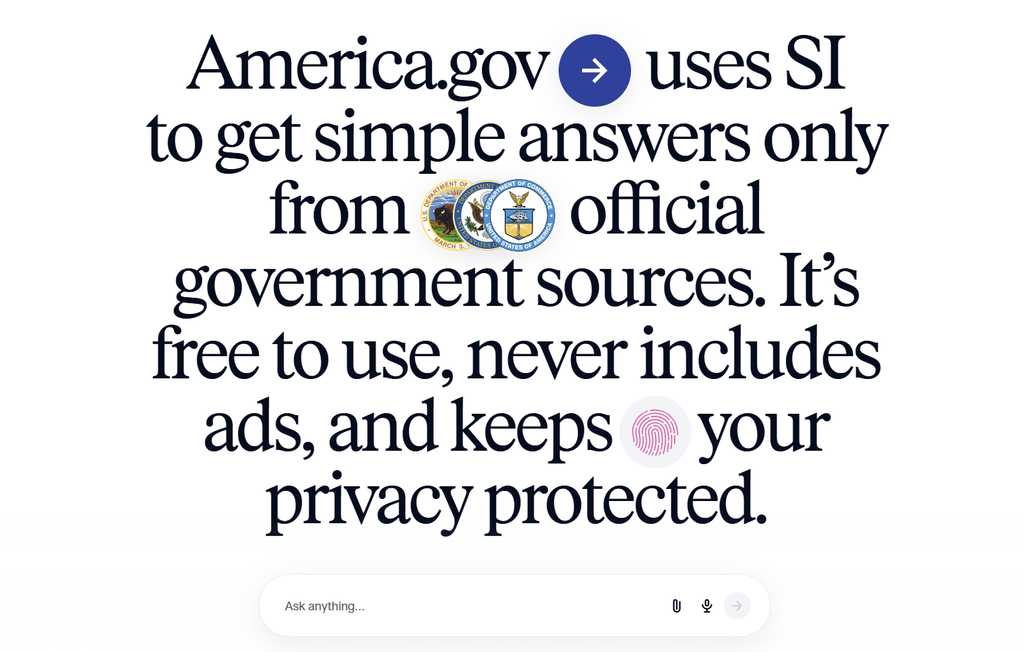
Think of it as a single front door to the entire federal government. Instead of hunting through dozens of agency websites, you can now go to America.gov, ask a question in plain language, and get an answer. As the site itself puts it: “No more wandering from site to site. America.gov brings the government together in one place.”
Here is why that matters to you.
The name change sounds like a mere headline grab. And legally, it changes almost nothing, at least for now. “Super Intelligence” covers exactly the same technology all of us already call AI.”
But words in government documents have a way of becoming budget line items.
The order gives the White House science adviser 60 days to propose an official legal definition of Super Intelligence. Law firms are already advising government contractors to expect “SI” to start showing up in new solicitations and statements of work.
And America.gov is not a suggestion. Agencies are directed to connect every public online service used by more than 100,000 people a year, with a few exceptions like IRS tax filing. Some of those services are used by millions. That means connecting their systems, their digital forms, and their logins. The White House budget office has 90 days to send agencies its instructions.
That is a lot of software, cloud capacity, and security work that did not exist on anyone’s to do list a month ago.
Now look at what was already happening before any of this.
According to the Brookings Institution, the value of federal AI contract funds went from $675 million in 2024 to $7.2 billion in 2026. That is more than ten times in two years.
Brookings also counted the number of federal AI contracts. It went from 472 in 2022 to 1,743 this year.
Here is the part most people are missing.
Brookings found that only 28 of 441 federal agencies have any AI contract at all. And the Defense Department accounts for 98.9% of the potential value of federal AI contracts. The researchers put it bluntly: every other agency has effectively become a rounding error.
That means outside the Pentagon, most of the federal government has barely started.
America.gov changes that math. Every agency with a large public facing online service is now being told to connect it to one AI powered front door. Agencies that have spent next to nothing on AI are now on the clock.
Now let’s be honest about the risks.
The government moves slowly. Brookings describes federal AI as still being in its experimental phase. Contracting remains a mix of mature and immature practices, and many vendors hold only one or two contracts.
Privacy is an open question too. Routing many agencies through one conversational system raises real questions under federal privacy law, even though the order says it does not create a central database of records on Americans.
And an executive order can be expanded, narrowed, or reversed without a vote. A theme built on policy can change when the policy does.
So what do you watch?
First, the budget office memo due within 90 days of the order, around the end of December. That tells you how fast agencies actually have to move.
Second, the proposed legal definition of Super Intelligence, due within 60 days, around the end of November. If it widens what counts as AI under federal law, the market for government AI contracts gets bigger with it.
Third, watch who wins the work. When contracts tied to America.gov start getting announced, that is where the money shows up.
Research firm Gartner expects worldwide AI spending to reach $2.52 trillion this year, up 44% from $1.75 trillion in 2025.
Whatever you want to call it, AI or SI, the largest buyer in the world just put its agencies on the clock.
Until next time,

Jean Fede