Good evening, and welcome to this week’s edition of Stealth Trades!
The foundation of the stock market continues to weaken.
Despite the S%P 500 sitting just 1-2% below all-time highs, there are clear and alarming cracks in the foundation. Nearly every breadth indicator I am monitoring shows deteriorating conditions, and an index being propped up by a shorter and shorter list of names.
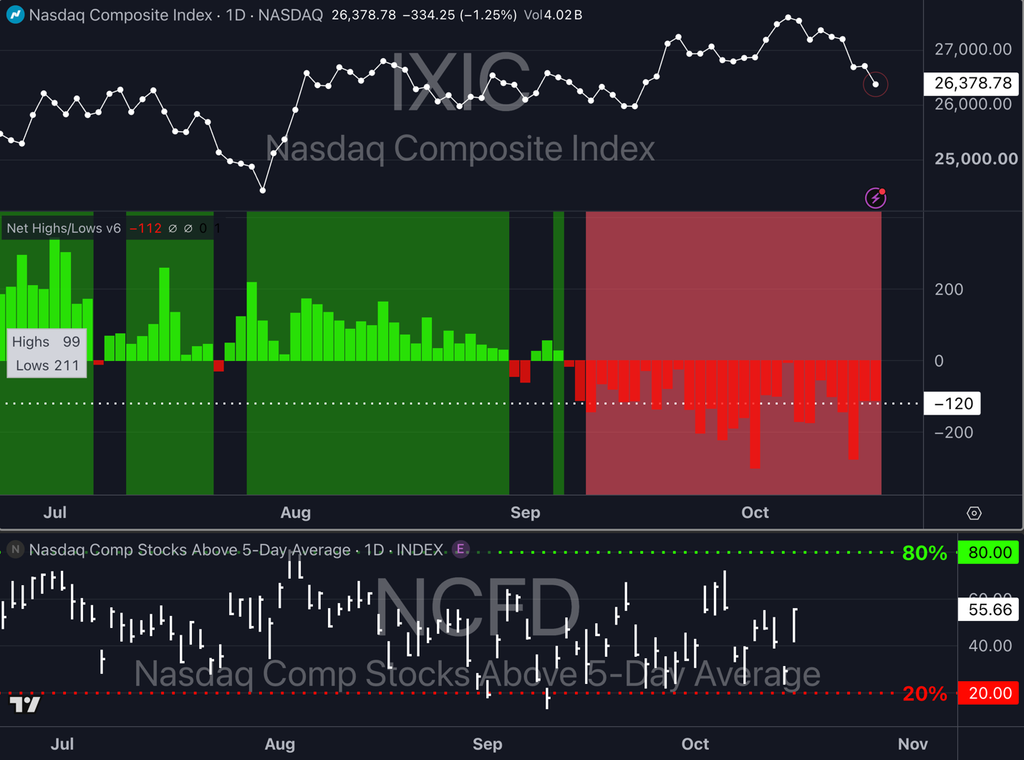
As of this morning, stocks have made more new lows than highs for 28 straight trading days.
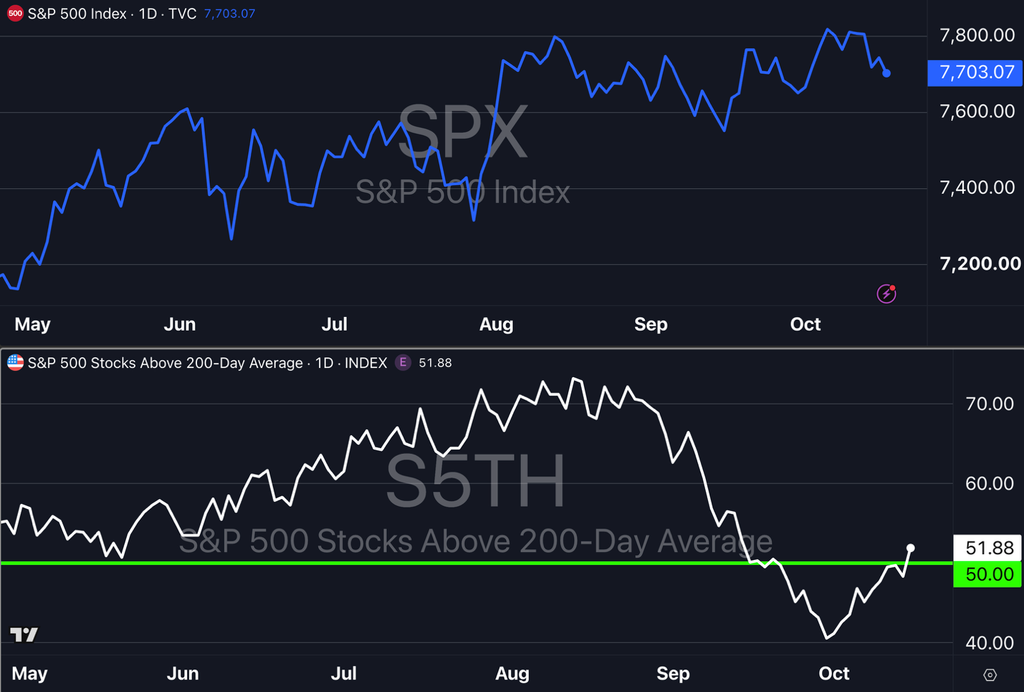
Right now, half of all stocks in the index are in long-term downtrends.
Only 52% are trading above their 200-day moving average.
We are seeing improvement here, however, rising from 40% at the start of the month. And the % above their 50-day average has climbed from 20% to 44%.
So, there’s hope of a recovery, but I still need to see more.
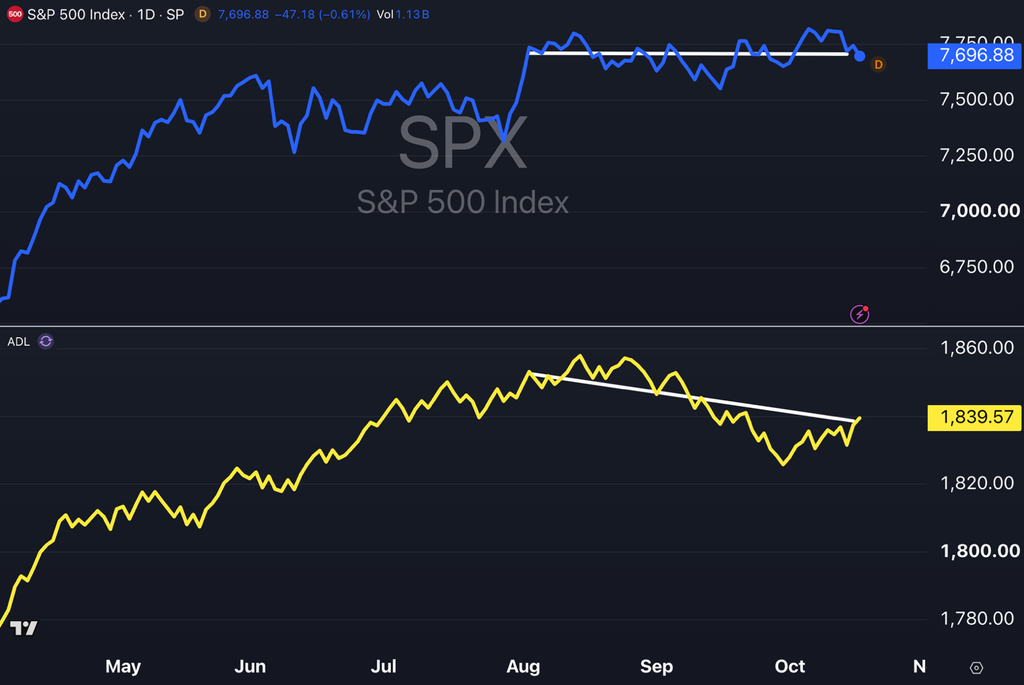
The advance decline line shown below in yellow tells a similar story of improvement but still lagging healthy levels.
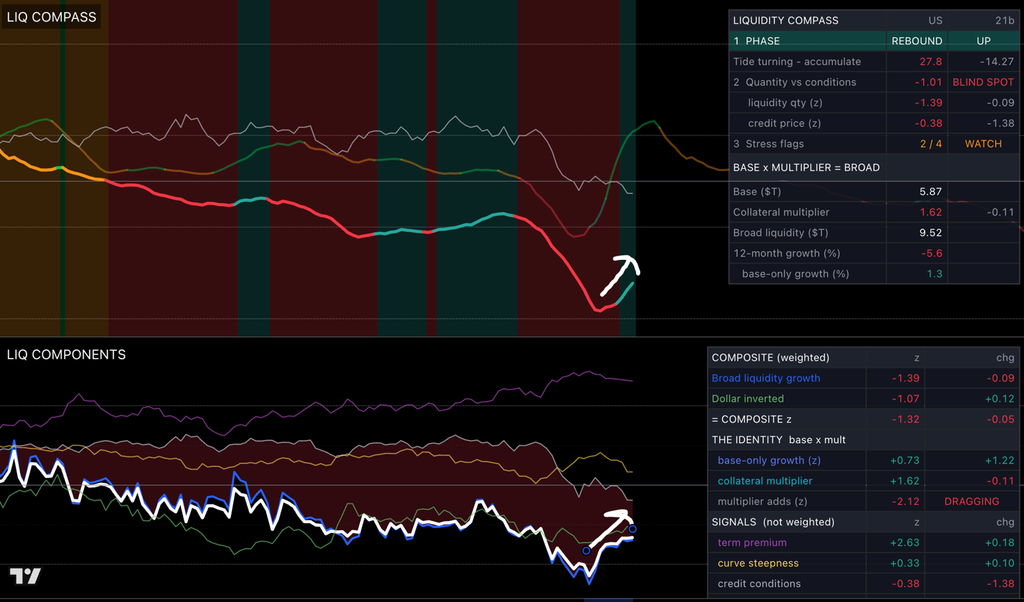
I have also been working on a new liquidity model that is still being tweaked. It shows similar near-term improvement, but we are still on the wrong side of capital flows.
But the only evidence that really matters is how well trades are working.
Two weeks ago, I highlighted the photonics sector and the setups forming across several stocks in the group.
Every one of those setups failed.
That’s my feedback. Breakouts aren’t running, bases are failing, and participation remains weak.
The main stocks holding this market up today are Apple (AAPL), Microsoft (MSFT) and Meta (META). If any of those breaks down, it will be difficult for the index to remain near its highs.
Further evidence of failing leadership can be seen in our Industry Strength indicator.
Over the last 30 days, the top performers are retail, entertainment, basic materials – groups that have not led at any point this year.
Basic materials and consumer staples are typically safety groups – places scared money goes to hide.
A strong market sees money flowing to risk assets. A weaker one seeks safety.
Hopefully, this is nothing more than a short-term correction to knock the froth off the market, push the leverage out of the big growth names, and set up the next big run higher.
This would be both normal and healthy.
But right now, I am keeping risk low. I am trading less, in smaller sizes, and only looking for A1 setups. If the trade doesn’t look perfect, I am not taking it.
Markets move fast. Conditions could improve quickly, especially if interest rates come down, we get a resolution in Iran, energy prices subside, and the odds of a rate hike come down.
But it is important, as traders, to identify when conditions are primed and when they are not. Right now, they are not.
Join me in Monday’s YouTube LIVE session at 9am ET. We will dive into this deeper and look for new opportunities.
Good evening, and welcome to this week’s edition of Stealth Trades!
Jean here again, filling in this week. Ross is home preparing for Hurricane Isaias, and to all of you who may be in its path, please stay safe. With that said, let’s jump into this.
On September 29, the White House signed two executive orders that most investors and traders scrolled past.
The first one changes a word. Federal agencies are now directed to stop saying “artificial intelligence” and start saying “Super Intelligence,” or “SI,” in their official correspondence, websites, reports, and policy documents.
The second one created America.gov
Think of it as a single front door to the entire federal government. Instead of hunting through dozens of agency websites, you can now go to America.gov, ask a question in plain language, and get an answer. As the site itself puts it: “No more wandering from site to site. America.gov brings the government together in one place.”
Here is why that matters to you.
The name change sounds like a mere headline grab. And legally, it changes almost nothing, at least for now. “Super Intelligence” covers exactly the same technology all of us already call AI.”
But words in government documents have a way of becoming budget line items.
The order gives the White House science adviser 60 days to propose an official legal definition of Super Intelligence. Law firms are already advising government contractors to expect “SI” to start showing up in new solicitations and statements of work.
And America.gov is not a suggestion. Agencies are directed to connect every public online service used by more than 100,000 people a year, with a few exceptions like IRS tax filing. Some of those services are used by millions. That means connecting their systems, their digital forms, and their logins. The White House budget office has 90 days to send agencies its instructions.
That is a lot of software, cloud capacity, and security work that did not exist on anyone’s to do list a month ago.
Now look at what was already happening before any of this.
According to the Brookings Institution, the value of federal AI contract funds went from $675 million in 2024 to $7.2 billion in 2026. That is more than ten times in two years.
Brookings also counted the number of federal AI contracts. It went from 472 in 2022 to 1,743 this year.
Here is the part most people are missing.
Brookings found that only 28 of 441 federal agencies have any AI contract at all. And the Defense Department accounts for 98.9% of the potential value of federal AI contracts. The researchers put it bluntly: every other agency has effectively become a rounding error.
That means outside the Pentagon, most of the federal government has barely started.
America.gov changes that math. Every agency with a large public facing online service is now being told to connect it to one AI powered front door. Agencies that have spent next to nothing on AI are now on the clock.
Now let’s be honest about the risks.
The government moves slowly. Brookings describes federal AI as still being in its experimental phase. Contracting remains a mix of mature and immature practices, and many vendors hold only one or two contracts.
Privacy is an open question too. Routing many agencies through one conversational system raises real questions under federal privacy law, even though the order says it does not create a central database of records on Americans.
And an executive order can be expanded, narrowed, or reversed without a vote. A theme built on policy can change when the policy does.
So what do you watch?
First, the budget office memo due within 90 days of the order, around the end of December. That tells you how fast agencies actually have to move.
Second, the proposed legal definition of Super Intelligence, due within 60 days, around the end of November. If it widens what counts as AI under federal law, the market for government AI contracts gets bigger with it.
Third, watch who wins the work. When contracts tied to America.gov start getting announced, that is where the money shows up.
Research firm Gartner expects worldwide AI spending to reach $2.52 trillion this year, up 44% from $1.75 trillion in 2025.
Whatever you want to call it, AI or SI, the largest buyer in the world just put its agencies on the clock.
Good evening, and welcome to this week’s edition of Stealth Trades!
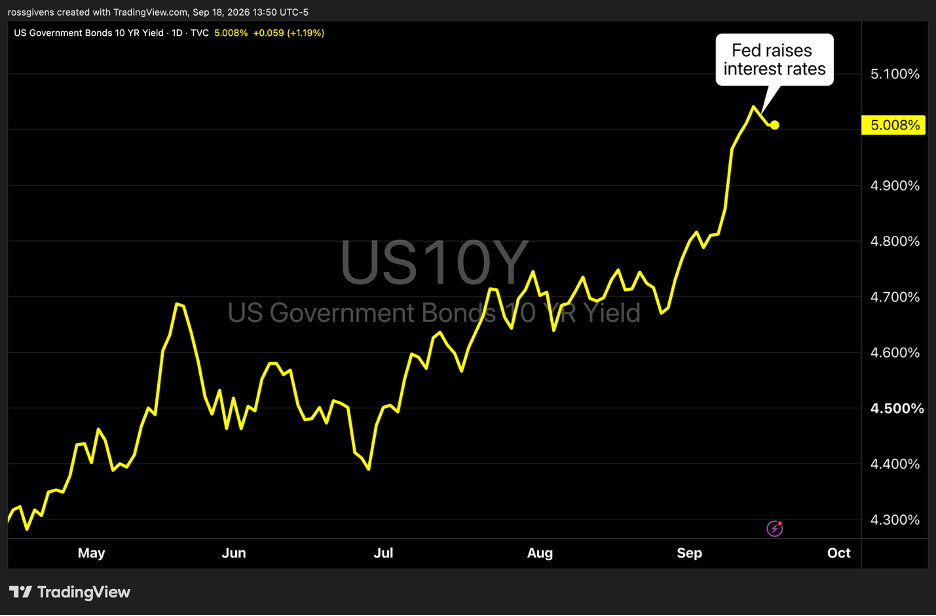
The 10-year Treasury yield just crossed 5.00%. Five years ago, it was 1.3%. And this affects both the bond market and the stock market.
Because for the first time since 2000, the yield on government debt is higher than on corporate earnings.
The Federal Reserve raised its interbank lending rate by 0.25% on Wednesday. Everyone knew this was coming.
In fact, the 10-year has been rising steadily for months.
How is this possible? How were rates surging higher without the Fed hiking?
Because the Federal Reserve doesn’t control interest rates. At least not anymore.
The Federal Reserve sets the Federal Funds Rate – the rate at which they lend money to banks overnight. They don’t set mortgage or auto rates.
Consumer rates are priced off of treasuries. If the 10-year government bond yield rises, so do mortgage rates and vice versa.
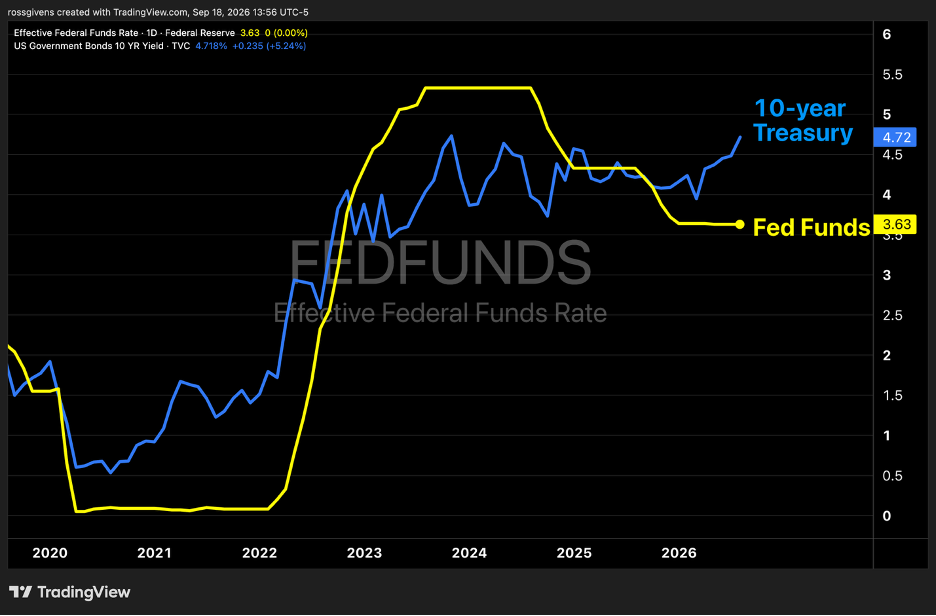
Now, historically, these two numbers have moved together. If the Fed cuts rates, competition for treasuries increases which drives bond prices up and yields down. In other words, they move together.
That has been the case for decades. But look what has happened over the last 12 months…
We have seen this before. You can see it at the start of the chart. After COVID, the Fed slashed rates to zero. 10-year bonds came down with it. But then they began rising – well ahead of any rate hike by the Fed.
That was the market anticipating higher rates. They knew they couldn’t stay that low. And they knew that trillions of dollars of money printing could have only one result – inflation.
They were right. And the Fed was forced to aggressively raise interest rates to fight it.
Today, that same pattern is playing out. The Fed hasn’t raised since 2023. In fact, they cut several times over the last few years. But bond yields have surged higher.
Why?
The same reason as last time. Our DC bureaucrats have made it clear that they will never stop spending. They will continue to borrow and print no matter the cost. Even in what most claim is a booming economy, they have to scrape together $2.5 trillion to fill the holes in their bloated budget.
There’s no fixing it. And now that debt is snowballing. Interest payments alone, without paying down any of the principle, now exceed a trillion dollars per year. We spend more on debt service than defense.
Think about what that means…
Imagine a borrower so far in the hole that he has to borrow even more just to cover the interest payments. That person is never going to pay it back. That person is going bankrupt. And so will Uncle Sam.
But Uncle Sam is a special kind of borrower. He has a power no other lender on Earth has – he can print money. And that’s what he’s doing to pay his bills.
This money printing is the sole cause of inflation. Not immigration, not corporate greed, not any other political excuse. The only thing that causes inflation is an increase in the money supply. More dollars chasing the same number of goods and services makes all prices rise.
Bond investors know this better than anyone. That’s why treasury yields soared post-COVID before the Fed acted. They knew what was coming. And the worst thing you can own in an inflationary environment is cash yielding 1% while prices are rising 7-8% a year. You lose money every day you hold them. So, they sold. Aggressively. And yields rose as a result.
The same thing is happening today. The writing is on the wall. The printing press will keep humming, the bureaucrats will keep spending, and the soaring inflation that Washington is determined to convince isn’t happening will continue to transpire.
So, what does this mean for stocks?
In the short-term, it’s anyone’s guess. But buying stock today with the intention of holding for 10 years into the future is likely to deliver suboptimal results.
Let me explain…
Every stock has an earnings yield. It represents how much an investor is getting in corporate earnings for every dollar he pays for the stock. Today, the S&P 500 index trades at 26 times earnings. That equates to a “yield” of around 3.86%. Compare that to what the Treasury pays you to take essentially no risk:
3-month Treasury bill 4.07% (Essentially risk free)
10-year Treasury note 4.95% (Rate risk only)
S&P 500 earnings yield 3.86% (Full equity risk)
The gap between the stock market’s earnings yield and the 10-year Treasury is called the equity risk premium – that’s the extra return you are supposed to be paid for taking stock risk. Historically it runs around 3% to 5%. Today it is negative 1%. The last time it went negative was at the top of the dot-com bubble in 2000, and it took 13 years for the market to make a new high.
I say this not to scare you but so you understand your options as an investor.
The caveat is this: expensive can get more expensive. This number tells us that stocks are overvalued, but not that prices will crash tomorrow.
Consider 1999. At the start of that year the Nasdaq Composite was already widely regarded as overvalued — trading at roughly 2,200 with valuations that had no precedent. It then went up more than 130% over the next 14 months, peaking above 5,000 in March 2000.
The S&P 500 was also already stretched in 1999 and added roughly 20% before it broke. Anyone who sold everything in January 1999 because “the market is overvalued” was right about the valuation and wrong about the timing by a year and a doubling.
Valuation tells you what your long-run returns are likely to be from here. It tells you almost nothing about the next six or twelve months.
Both things are true at once: the ten-year buy-and-hold math is poor at these prices, and the run can continue for a while before it stops. So, the question is not “should I get out.” The question is “how much risk do I want to be carrying when the party comes to an end?”
And the answer depends on where you are in life.
If you are in or near retirement: this is a reasonable place to de-risk.
For the last fifteen years, cash paid nothing. Those who parked money in fixed income are living a completely different life than their peers who held stocks through an historic bull market. If you’re one of the stockholders, I applaud you. Your bet paid off handsomely.
But today is a different story.
A 3-month Treasury bill pays about 4% a year. It is now paying you more than the stock market’s earnings yield, with almost zero risk. Investors are no longer forced to choose between “fully invested” and “earning zero.”
If I were well into retirement or a few years from it and sitting on large gains, I would be moving 20% to 30% of my stock exposure into short-term Treasuries. It’s not going to make you rich, but it’s a lot easier to sleep at night.
The simplest way to do it is to buy SGOV – the iShares 0-3 Month Treasury Bond ETF. Roughly $100 a share, it holds a basket of T-bills and pays a cash dividend every month. You can buy it in the same brokerage account where your stocks are with a few clicks of the mouse. Rolling actual T-bills at auction through your broker or Treasury Direct works the same way if you prefer to hold the bills directly (I don’t).
Your only real risk in doing this is opportunity cost. If the market goes up another 20% from here, the T-bill slice will earn 4% instead of 20%. That is the price of de-risking. But, if I was comfortable, no longer working, and had no plan to earn the money back, it’s a price I would be willing to pay.
I’m 43. I’m still working and still accumulating. So, what am I doing?
I haven’t sold all my stock exposure, but I’m not adding any either. Instead, my focus is on commodities. And here’s why…
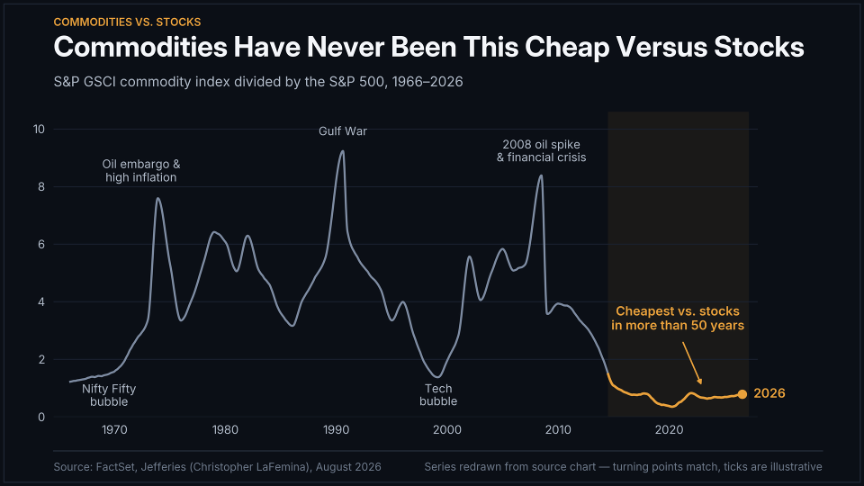
The chart above shows the value of a basket of commodities in relation to stocks. Never in 50 years have they been this cheap.
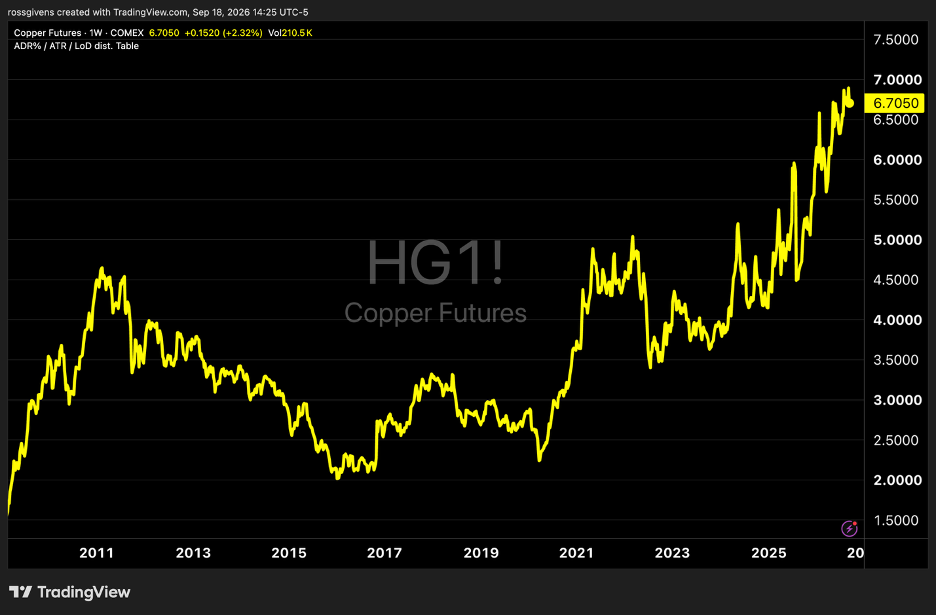
Take copper for example. I have discussed the supply shortage in the copper market in depth in previous newsletters, but let’s just look at the price.
Most people look at this chart and say “copper is expensive.”
Is it?
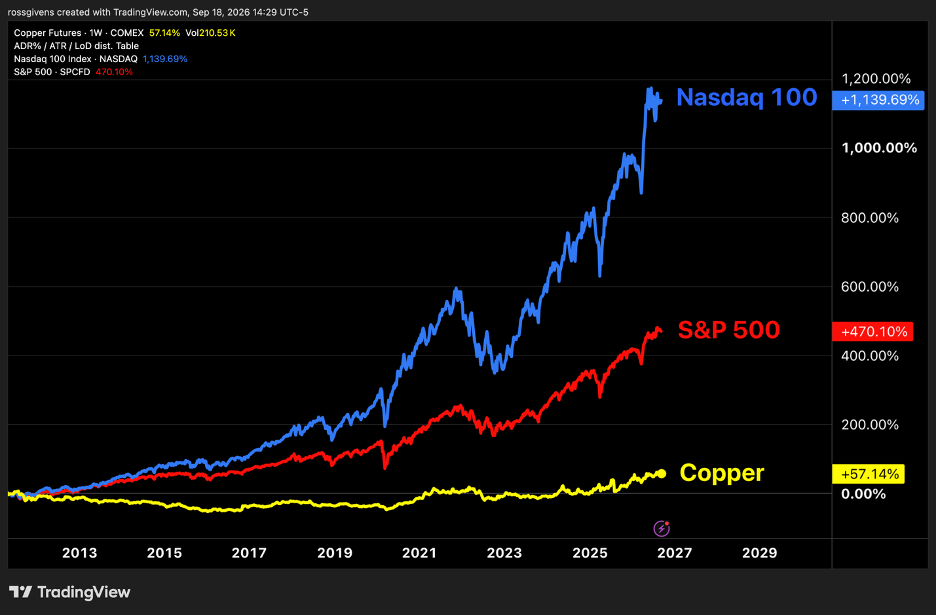
It’s only up 57% over the last 15 years. Stocks are up 10-20X that. And none of the AI hype can even come to fruition without millions of tonnes of copper. No robots, no EVs, no chatbots – none of it.
Call me crazy, but owning one of the most in-demand commodities of the next decade sounds more appealing than owning one of the most overpriced stock markets in history.
The commodity mechanism is simple supply and demand. When commodities are this cheap for this long, nobody funds new supply — no new mines, no new oil fields, no new refineries or smelters. Capacity shrinks.
Then demand shows up, and there is nothing on the shelf. Buyers compete for the limited supply and drive prices higher. This is what triggers supercycles that run for years. That is what happened in the 1970s, it’s what happened in the 2000s and it’s what we are going to see again.
I have rambled longer than usual in this week’s addition, so I will end it with this…
There will be another 2000 or another 2008. There will be more crashes like there always have been. And when that happens, my advice will change dramatically. But this is the current state of the equity market.
I’m still trading stocks. I’m still taking swing trades that I hold for a few weeks to months. But I cannot in good conscience put serious long-term dollars into an index trading at what history says is the worst place to buy. Cheap markets are the ones worth buying and holding. This is not one of them. This market is for trading.
Good evening, and welcome to this week’s edition of Stealth Trades!
I have made clear my bullish stance on copper for all of 2026. And my thesis has not changed.
Supply is shrinking. Demand is growing. And the price will almost certainly go up.
Today, in this weekly update, I want to share the proof. Here are ten charts and graphics that illustrate the coming copper crisis.
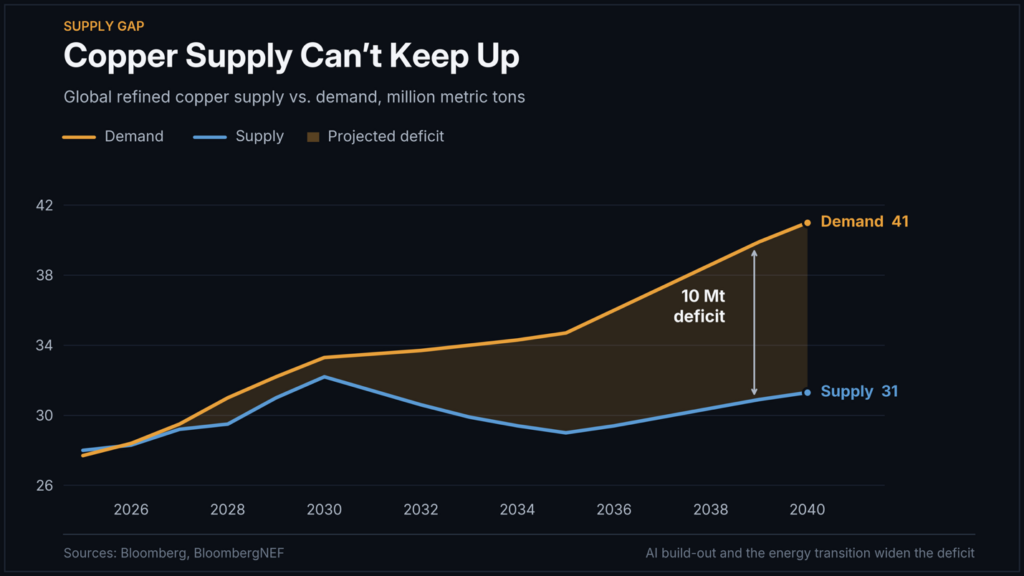
This one is pretty self-explanatory. Supply cannot keep up with demand and that gap is expected to widen significantly over the next decade.
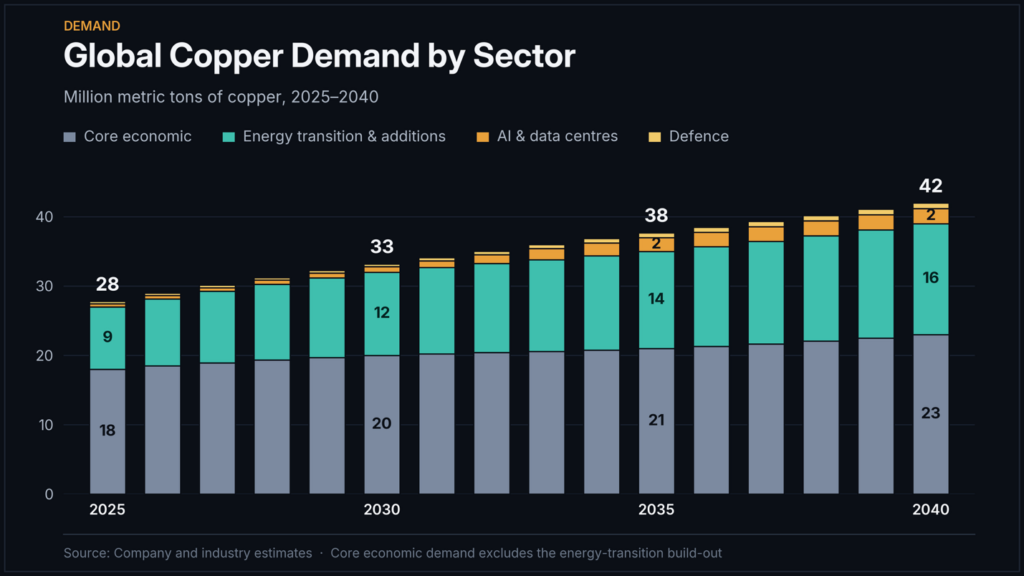
One of the counter arguments to this claim is that data centers buildouts could take longer than expected, and that new technology like photonics will lower copper demand.
But as you can see, data centers are just a small fraction of that demand.
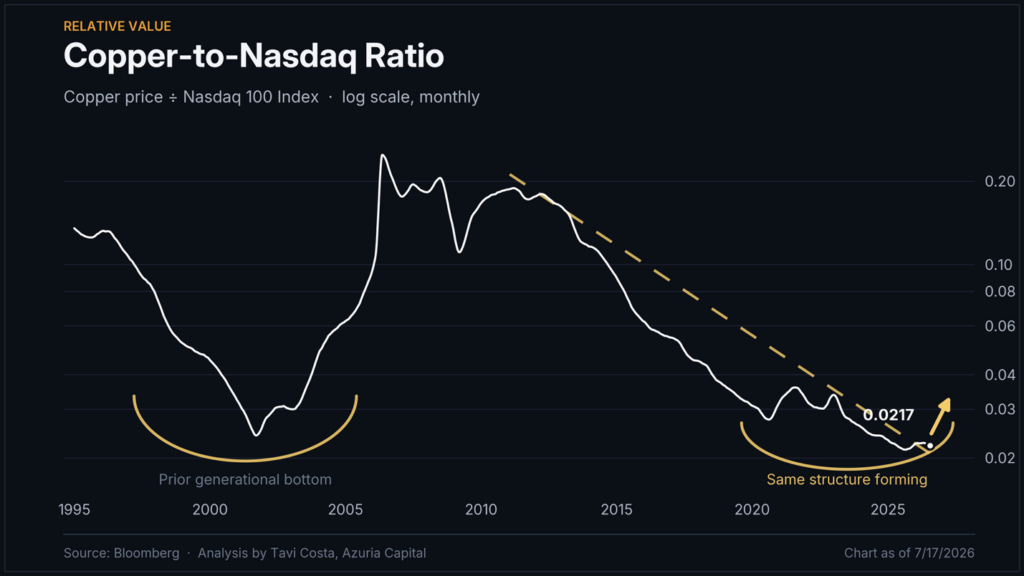
Here’s a chart you’ve probably never seen before. It is the copper-to-Nasdaq ratio.
Copper futures may be at all-time highs. But on a relative basis, it trades at its lowest level to stocks in decades.
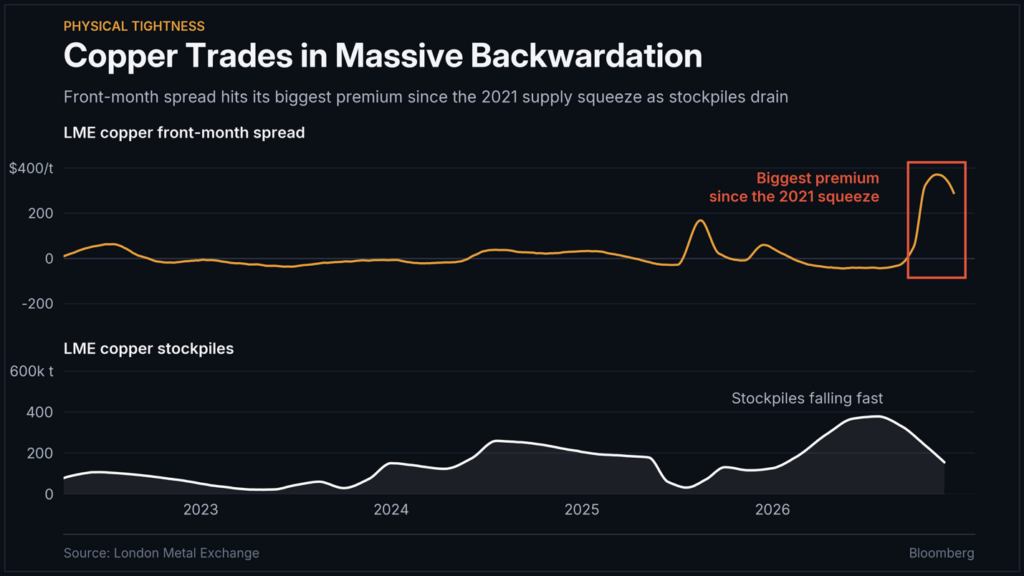
In addition, inventories are shrinking.
The “backwardation” is when front month futures contracts trade at a premium to contracts with a delivery date several months into the future. That is what is happening now, and it is the opposite of what we usually see.
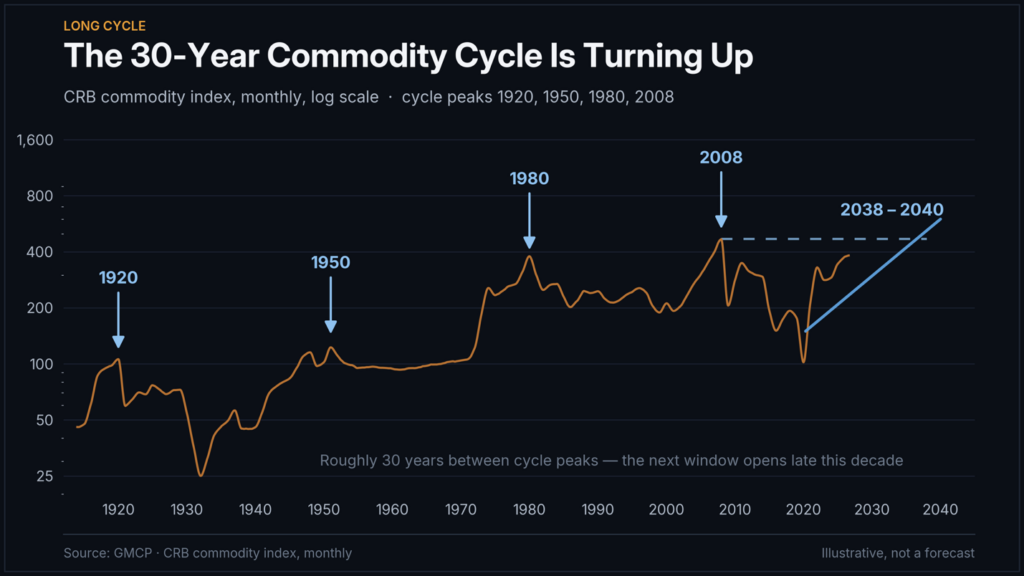
Then there’s the often quoted “30-year commodity cycle.”
Personally, I’m not a big believer in these mythical multi-decade cycles. Technology is advancing at 10,000X the rate it was a century ago. These cycles should speed up. So, take that one with a grain of salt.
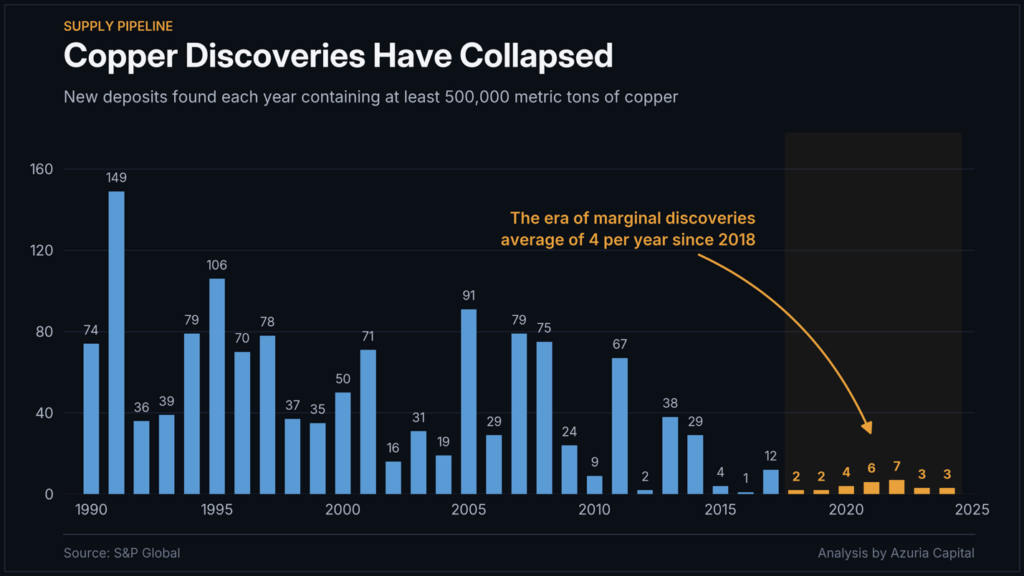
This one, on the other hand, is hard to ignore.
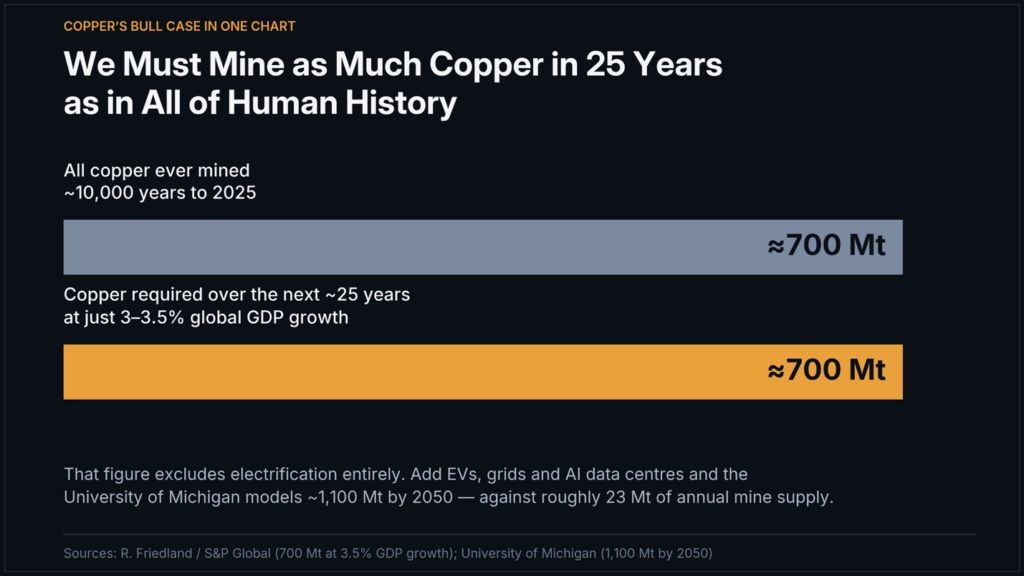
Discoveries of new copper deposits are marginal at best. And look how much we need to find.
Globally, we need roughly 700 metric tons of copper over the next 25 years. That’s equal to all the copper ever mined in the history of human civilization.
Then there are the charts.
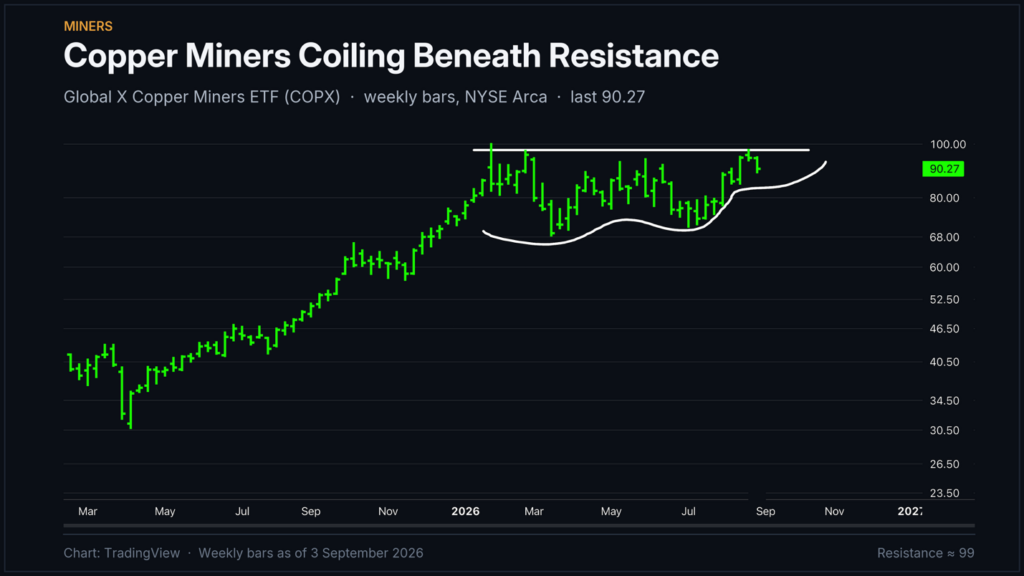
The Global X Copper Miners ETF – ticker COPX, is setting up in a classic breakout pattern on the weekly chart.
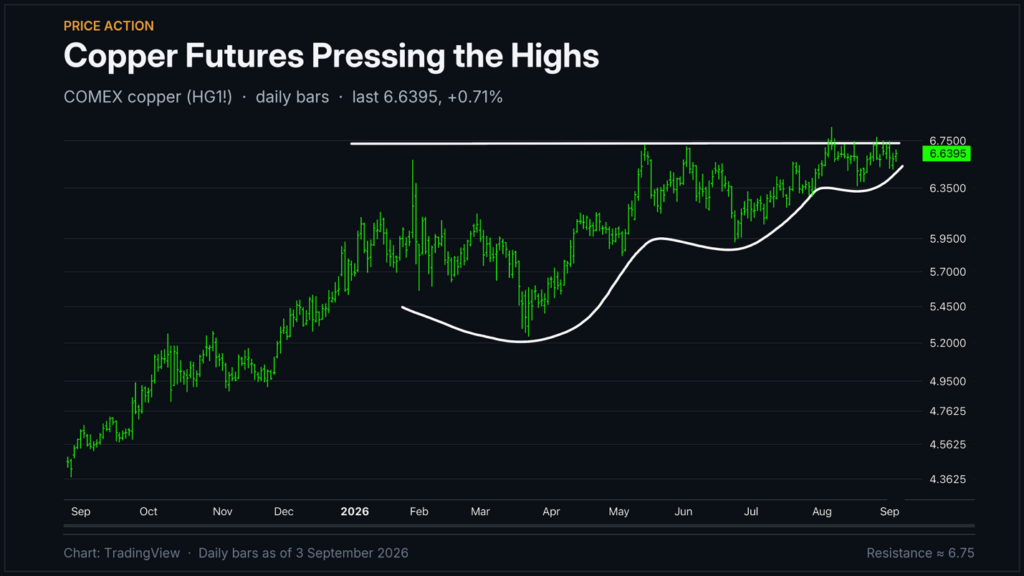
Copper futures are showing a similar pattern.
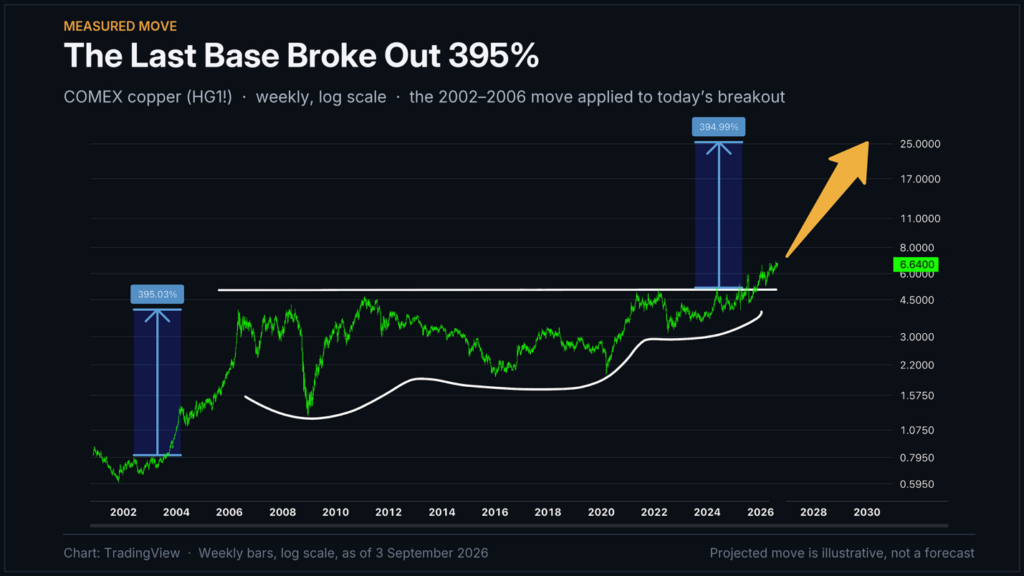
And, if history repeats, we could be looking at $25 per pound by 2030.
This is my case for copper and why I believe it offers one of the most asymmetrical opportunities in the commodities sector.
Good evening, and welcome to this week’s edition of Stealth Trades!
The new Fed Chairman just blamed the Federal Reserve for the inflation of the last five and a half years.
Not supply chains. Not the pandemic. Not Congress.
The Fed.
Kevin Warsh gave his first Jackson Hole keynote as Chairman on Friday, and buried in the middle of it was a sentence no sitting Fed chief has ever said out loud:
“There is one signal nobody can miss: The responsibility for 65 months of sustained, elevated inflation sits squarely with the central bank. And that is where it belongs.”
He took the blame for all of it. And I don’t think he would start his term that way unless you intend to be the guy who ends it.
Here is why that matters for your money.
The market has spent this entire year pricing in rate cuts. As of Friday, the odds of a cut at the September meeting are under 2%. The odds of a rate hike moved from 35% to 46% in the hour after he spoke.
And the inflation numbers are even worse than the headlines
12-month PCE increase: 3.7%.
6-month PCE increase: 4.1%.
Inflation is NOT cooling off. It is reaccelerating.
Warsh took it even further. He broke the PCE basket into its 199 individual components and counted how many are rising faster than 3% a year.
The answer is 54%.
Before the pandemic, that number averaged 32%.
For four years, every hot inflation print got explained away. It’s used cars. It’s eggs. It’s shipping containers. It’s one weird category dragging up the average.
That excuse is dead. When more than half of everything you buy is running above 3%, it is not eggs.
Policy is not tight, and he said so clearly.
This is the part that should reset your expectations.
Warsh said he would be hard pressed to describe broad financial conditions as restrictive.
He even brought receipts…
Business capital spending is up around 9% over the past four quarters, the fastest since 2021.
S&P 500 corporate profits are up more than 20% in a year.
Corporate credit spreads sit near the low end of their historical range with heavy issuance.
Banks even told the Fed in July that lending standards for commercial and industrial loans are on the EASY end of their range.
Even equity volatility is low.
Here is the simplest way to see it. The effective fed funds rate is 3.63%. Inflation is 3.7%.
After inflation, the Fed is charging nothing. Wall Street banks have been getting free money.
The “restrictive” policy they like to complain about is anything but.
So, the business environment is strong. Unemployment claims are low. But inflation is still too high. And that is his top priority.
Gee… I wonder what he will do?
He couldn’t have made it any clearer. He is not going to cut rates. He’s going to raise them. And he will keep raising them until we finally see, for the first time in six years, sub-2% annual inflation.
Fed chairmen tend to sort of pick a team. Either they are focused on the stock market and keeping the business environment competitive, or they are focused on everyday citizens and prioritize keeping prices stable.
They have a mandate to do both. But that is easier said than done. At some point, they have to make a decision. And Warsh just told you which way he will go when pressed.
The next Fed meeting is September 16th.
Warsh revealed his standard in this morning’s speech. He said he must be confident inflation is moving to target clearly, and at sufficient speed. Otherwise, in his words, they have work to do.
“Work to do” does not mean cutting. It does not mean looser financial conditions. It means tighter ones.
Warsh has no plans to use unconventional policy tools. He made clear they should be used sparingly, if at all.
He will not be riding to the rescue the first time the stock market has a bad month.
The rescue window is closing. And the stock market will not be propped up by artificially low rates.
Good evening, and welcome to this week’s edition of Stealth Trades!
There is a structural shortage in the copper market driving prices higher. And all signs point to the situation getting worse, not better.
Translation?
The price of copper keeps going up.
Right now, there are about 200,000 tonnes of copper left in the London Metal Exchange warehouse system. That’s the pile the entire world outside of China and America borrows from when it runs short.
Roughly half of that is already spoken for.
Inventories there have fallen for 42 straight trading days. The longest drawdown streak since 2014.
On top of that, the Congo just banned exports of copper concentrate.
And the United States pulled in more than 200,000 tonnes of refined copper in the month of July alone — the biggest month in twelve years.
Right now, copper prices are near all-time highs – setting up in a textbook breakout pattern about to explode even higher. More on that in a minute.
The supply/demand imbalance in the copper market is huge. Every legitimate forecast shows global supply falling short of the rising demand coming from data centers and grid expansions.
Global mine production fell 1.6% over the first five months of this year. Not grew slower. FELL.
And the International Copper Study Group thinks refined production grows a whopping four tenths of one percent for the full year.
And unlike most shortages, the problem cannot be fixed with money. It takes 10-15 years to get a new copper mine up to production. And today’s copper ore is a fraction of the purity we mined 50 years ago.
Add it all up, and you get a market with more buyers than sellers. And when that happens, the result is always the same.
The chart tells the story…
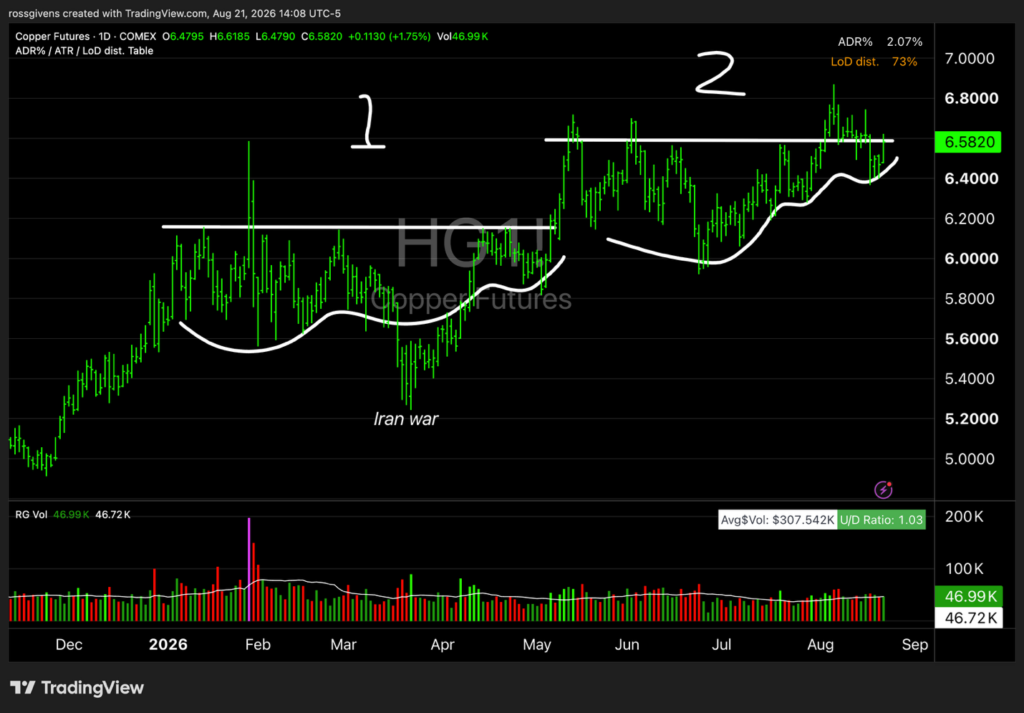
This is what I call a “base-on-base” formation. After a strong run up in late 2025, copper formed a 4-month consolidation pattern before making new all-time highs.
But the summer was brutal for tech stocks. A lot of the big AI names retraced or went nowhere. With proposed data centers being the key contributor to new supply, that same choppy action carried over to copper.
But the smart money kept buying. And it formed another textbook shallowing base.
Nothing is guaranteed. But these base-on-base patterns can deliver outsized moves higher since the available supply has contracted even further.
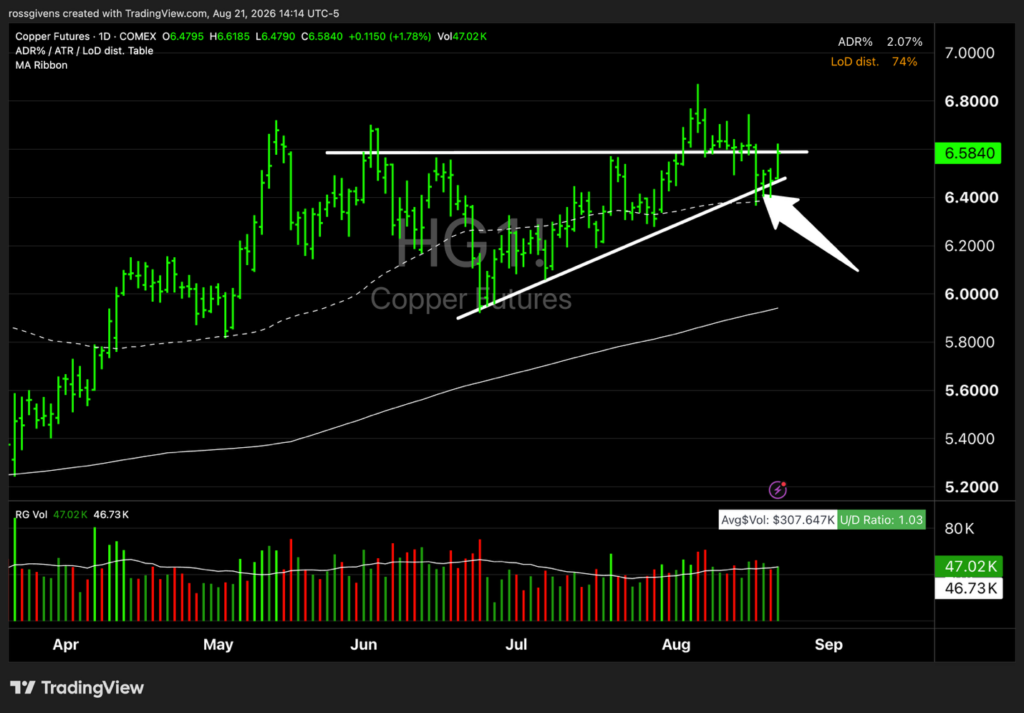
On Tuesday, I started buying – right there at that arrow when copper pulled back to its 50-day moving average and the lower edge of its trendline.
If the structure holds, this will likely be the last dip before the next surge higher.
I bought futures contracts, but if you want exposure there are other ways to get it.
The simplest is CPER – the United States Copper Index Fund. It is an exchange traded fund that trades just like a stock and can be purchased in any account.
Those who prefer miners should look at the Global X Copper Miners ETF, ticker COPX.
It holds a basket of copper mining stocks and just broke out to new multi-month highs.
Good evening, and welcome to this week’s edition of Stealth Trades!
Every market crash leaves the same fingerprints.
Before the 2000 top and before the 2007 top, the same warning signs showed up. These are specific, dated, measurable events.
There are a total of 14 bear market signals.
Thirteen of them have already triggered. The last one has not.
This does not mean we are days or weeks away from a crash. The first 13 signals arrived by January in 1999, and the Nasdaq went on to double that year before eventually crashing.
So, don’t let this scare you. But I would rather you be aware of where we stand than caught off guard.
The first four signals are the easiest to spot:
#1 – Record debt issuance in the hot sector.
Telecom companies issued over five hundred billion dollars of bonds between 1996 and 2001. That was the fuel.
Morgan Stanley puts AI-related debt issuance at roughly five hundred seventy billion dollars this year. Bonds from the hyperscalers hit two hundred twenty-five billion by mid-year — up nearly a thousand percent from last year.
Check.
#2 – The debt moves off the balance sheet.
In 2006, Wall Street issued about $521 billion dollars of CDOs — the vehicles that hid mortgage risk where you couldn’t see it.
Moody’s now counts $1.2 trillion dollars of off-balance-sheet AI commitments. Microsoft alone disclosed $329 billion dollars of leases that haven’t even started yet. That number was $93 billion a year earlier.
And starting next fiscal year, Microsoft extends the assumed useful life of its data centers from fifteen years to twenty-five. It’s a trick to shrink depreciation and create the illusion that profits are higher than they are.
Check.
#3 – Sellers start financing buyers.
In the last 90’s, Lucent lent $8 billion to its own customers so they could buy Lucent equipment — then booked those loans as revenue. Nortel did the same.
By 2000, McKinsey $25.6 billion of this across 9 equipment makers.
Today Nvidia holds $30 billion of equity in OpenAI, $10 billion committed to Anthropic, and a signed agreement to buy CoreWeave’s unsold capacity through 2032.
Checked.
#4 – Capital spending outruns cash flow.
In the 2001 telecom cycle, capital spending outran revenue growth by about 32%. Everyone swore the demand was coming.
Today, AI capex is outrunning AI revenue by 46%. Wider than the telecom bust — and that number comes from CreditSights.
And Oracle spent $55 billion on capex last fiscal year against -$23 billion of free cash flow.
Check.
The next 4 markers come from the crowd – retail investors like you and I who act predictably at euphoric peaks.
#5 – Record margin debt.
Margin debt is money investors borrow against their own portfolios to buy more stock. It peaked six months before the 2000 top and four months before the 2007 top.
Today: $1.53 trillion; up 51.5% in a year.
That growth rate has appeared exactly three times before. 2000. 2007. 2021.
Check.
$6 – Record IPO volume.
1999 produced roughly 480 internet IPOs with an average first-day pop of seventy-one percent.
American companies raised $251 billion of equity in the first half of this year – an all-time record.
IPOs alone were $148 billion. That matches the entire record year of 2021 — in six months. And SpaceX by itself raised $86 billion, the largest IPO in history.
In 1999, the mania was the speculation and wild moves. Today, it’s the size.
Check.
#7 – Retail investors pile into leverage.
1.2 trillion dollars went into US-listed ETFs this year — double last year’s pace. Semiconductors are the number one sector.
And there are now leveraged chip funds — products designed to deliver two or three times the daily move of an already violent sector — pulling in record money. They even had them for SpaceX the week it went public.
Check.
#8 – Insiders sell and nobody buys.
Angelo Mozilo sold 139 million dollars of Countrywide stock in 2006 and 2007 while defending the loan book on television.
Over the last twelve months, insiders at Nvidia, Palantir, Alphabet and Meta sold 3.4 billion dollars of stock.
Insider purchases over that same stretch? Zero. Not one share.
Check.
There are also two “symbolic signals.”
#9 – The Super Bowl.
In the 2000 Super Bowl, 17 dot-com companies bought Super Bowl ads at $2.2million apiece. By the next year’s game, only 3 of those 17 companies still existed.
We saw it again four years ago – February 2022. They nicknamed it the Crypto Bowl. FTX, Coinbase, Crypto dot com and eToro spent $44 million dollars in a single afternoon. Larry David for FTX. LeBron James for Crypto dot com.
FTX filed for bankruptcy nine months later. The founder went to prison.
Coinbase stock finished 2022 down 86%.
Crypto dot com cut 20% of its workforce that June. Then they did it again in January.
And at the next Super Bowl? Zero crypto ads. The deals all fell apart.
February 8th of this year, 23% of the Super Bowl was AI companies. 15 ads out of 66. OpenAI. Google. Amazon. Meta. Anthropic.
To be clear, none of this tells you the day of the top. Especially in this market.
But it tells us we’re in the neighborhood.
Also… check.
#10 – The picks-and-shovels supplier becomes the most valuable company on earth.
Cisco sold the routers that built the internet. On March 27th, 2000, Cisco passed Microsoft to become the most valuable company in the world.
Seventeen days after the Nasdaq peaked.
On May 13th of this year, Nvidia became the first company in history worth $5.5 trillion dollars. The high of the Nasdaq, as of today, was three weeks later on June 3rd.
Check.
#11 – The regulators start writing memos.
The Bank for International Settlements in March. The Federal Reserve in May. The Bank of England in July. And Moody’s on July 24th, warning that “unprecedented” AI spending threatens the credit quality of Amazon, Meta and Alphabet.
The BIS has its own word for how this is being financed – shadow borrowing. Roughly 15% of the entire private direct-lending market — a market north of a trillion dollars — is now lending into AI and tech. Four years ago, that was basically nothing.
In July, the Bank of England published a chart of how expensive American stocks are relative to bonds, and wrote that it has moved toward “levels not seen since the dot-com bubble.”
And that’s coming from a central bank.
Check
The final three markets come from the credit market. These, in my opinion, are the ones that actually matter.
#12 – Credit in the hot sector turns while everything else stays calm.
The ABX index tracked subprime mortgage bonds. On January 19th, 2007, the BBB-minus slice traded at 97 and a half. By February 27th it was at 62.
Down 36% in five weeks.
Today, Oracle’s five-year credit default swaps went from 145 basis points in January to over 215 in July. It’s an all-time record — above where they traded in the 2008 financial crisis. CoreWeave’s are north of 800.
Check.
#13 – The funding market starts choking.
In June of 2007, Merrill Lynch seized 850 million dollars of AAA-rated collateral from a Bear Stearns hedge fund — and couldn’t find a buyer for it. That was the market discovering, in public, that the paper had no price.
Today, coverage on hyperscaler bond deals — how many buyers show up per dollar offered — fell from about five times in February to under two times in July.
And CoreWeave’s term loan repriced 125 basis points wider, with lenders forcing back maintenance covenants that have been absent from leveraged loans for over a decade.
Check.
And finally, the one that has not yet fired.
#14 – Lenders get scared.
When you loan money to the US government, you get paid a little bit of interest. When you loan money to a risky company that might not pay you back, you demand more.
That difference is what matters.
When lenders are relaxed, that gap is small. When lenders get scared, they demand more, and the gap gets wide.
Right now, that gap is 2.7 percentage points.
America’s riskiest companies are borrowing at less than three points above the US government.
That is near the smallest that gap has ever been. Smaller than it was in 2021. Lenders are charging almost nothing to take real risk.
That gap has a name, by the way. On Wall Street they call it the ‘high yield spread.’ And it is the single most reliable warning light of a pending crash.
In 2007 it sat at 2.3 percent in the spring. By August it was at 4 percent. Four months before the S&P’s peak.
Back in 2000, that gap started widening in the spring. Once the gap exceeded 3.5 percent, it never came back. By November of that year, the Bank of England noted junk borrowing costs had reached the levels of the early 1990s recession.
Credit was pricing a recession. Stocks were pricing perfection.
Credit was right.
Here’s the picture today…
Oracle’s default insurance is at a record above 2008. Lenders are demanding covenants they haven’t asked for in a decade. CoreWeave is borrowing at 15% interest. And broad corporate credit is priced like nothing is wrong at all.
It sounds like a contradiction. And it is. That’s the whole point. This is exactly what early 2007 looked like before peaking later that year.
So, this one is still unchecked. But it’s the one to watch.
Open up TradingView and chart the following ticker symbol: BAMLH0A0HYM2.
That is the symbol for the High Yield Index Spread. Today it sits at 2.71. When it hits 3.5, things are getting ugly. And if it stays there, elevated, above 3.5% for more than a month? Get out.
There’s a pattern that has repeated with every great technology for 150 years.
Every time this country builds something enormous, the same thing happens. Every single time. And it has never once — not one time in a hundred and fifty years — worked out the way the investors expected.
There is always a shift – from the companies building the technology to the ones using it – that destroys investors in the first group of stocks and delivers life-changing returns for those in the latter.
The same shift will happen with AI stocks – not if, only when. The question is, is it happening right now? Because there is over 150 years of precedent for how the final stage of AI is going to play out.
Start with the railroads. The most important thing America built in the 19th century. Thirty-five thousand miles of new track laid between 1866 and 1873. It worked. It connected a continent.
And by 1877, twenty percent of American railroad track mileage was in receivership. A fifth of the network — bankrupt. Forty percent of all railroad bonds were in default.
Railroad stocks lost sixty percent of their value. When Jay Cooke and Company went under in September of 1873, the New York Stock Exchange closed its doors for ten days for the first time in its history.
Now jump to the internet; fiber optics. In the five years after 1996, telecom companies poured more than 500 billion dollars into cable.
By the early 2000s, less than 2 percent of it was being used.
Global Crossing raised about 20 billion dollars, laid a hundred thousand miles of undersea fiber, and filed for bankruptcy in January of 2002. Its assets sold for pennies on the dollar of what it cost to build.
So who got rich off all that fiber? Google. Amazon. Netflix. Companies that never laid a single mile of it.
They built their empires on bandwidth that was practically free — because somebody else had already gone broke providing it.
The same is true of the airlines. The airplane might be the most transformative machine of the 20th century. Warren Buffett said that as of 1992, all the money made by every airline company in this country since the dawn of aviation added up to zero. Absolutely zero. Between 2000 and 2008 they lost another sixty billion. And this year the industry’s own forecast has it earning about 6.8% on capital that costs them 8.2% — which means it is still, right now, in 2026, losing money for the people who fund it.
Look, here’s the thing…
The technology always works. That’s not the question. The question is who gets paid for it. And the answer is almost never the people who built it. It’s the people who use it.
The only question is: When will the shift happen?
Last month’s blow up of the Situational Awareness hedge fund happened for 2 reasons:
Aschenbrenner used 4:1 leverage on the long side
AI infrastructure stocks cratered while software ripped higher
He was long infrastructure – Coreweave, Nebius, Micron, etc. All of those stocks fell 30-50% in a month.
At the same time, he was short software – Workday, Microsoft, Adobe, Salesforce. Those stocks all went up.
Throw in some leverage, and that’s how to turn $45 billion into $10 billion in a month.
Painful lesson.
But it showed a shift in the AI theme. The market didn’t crash; money just walked out of one end of the AI trade and into the other.
Many investors assume that those who build the new technology will see the greatest investment yield. But there is no relationship between those two things. There never has been.
Amazon spent about 131 billion dollars on capital expenditure in 2025 — roughly 95 cents of every dollar the whole business generated in operating cash, poured straight into the ground. This year they’re guiding to $220 billion.
Oracle’s free cash flow went negative, and its long-term debt nearly doubled.
And CoreWeave — one of Leopold’s biggest positions — is carrying term loans at 11-15% interest. All so the business can steadily burn cash.
Valuations have gotten, uhhh… optimistic. And they won’t be justified forever. Many of the big winners of the last three years are nearing long term peaks.
The AI infrastructure trade that has been powering this market for the last four years is likely to shift in the next 12 months.
It happened to railroads in a decade. Fiber took about five. We are currently 4 years into the AI buildout which, to me, feels like the 8th inning.
I’m not saying the stock market is going to crash. But I do expect to see rotation. Money will shift from stocks building a commodity (compute) that will only become cheaper every year, to the companies using the commodity to build an empire.
And there is a simple test to determine which you have. Ask yourself this:
When compute becomes meaningfully cheaper, will it help this company or hurt it?
Good evening, and welcome to this week’s edition of Stealth Trades!
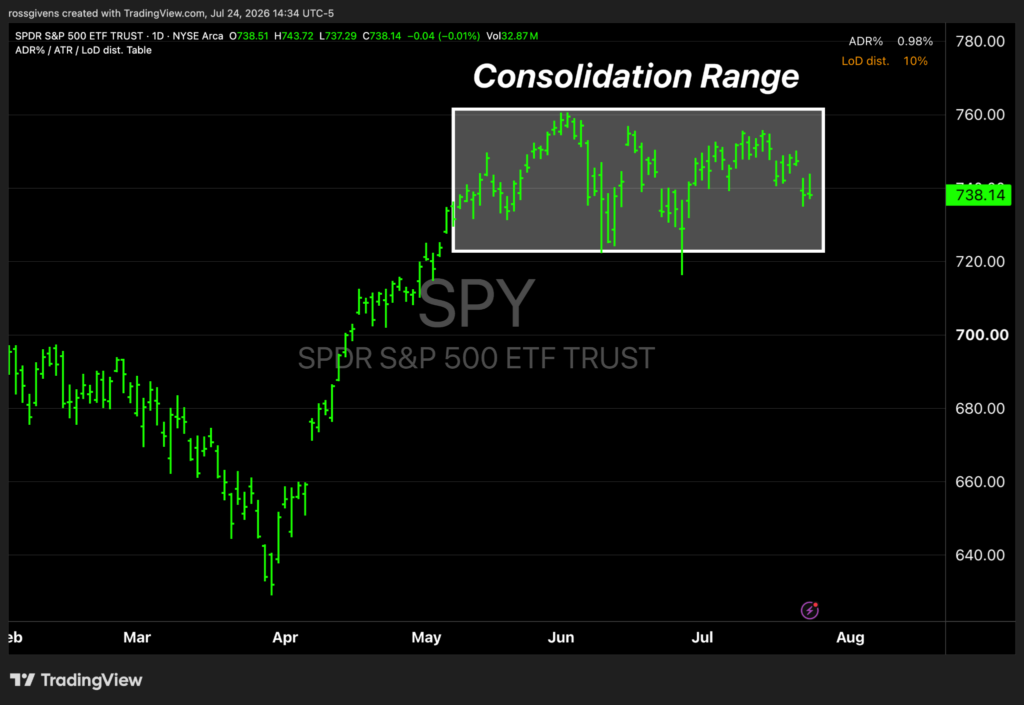
The markets remain quiet and continue to bounce around in the same 5% range they have been all summer.
This is normal. In fact, it is necessary.
After the big rally we saw in April and May, stocks need a chance to digest the move.
This is what sets up the next leg higher.
But it is also boring.
So, instead of wasting your time with a deep dive and how things look “fine” I decided instead to feature a recent IPO setting up in a clean pre-breakout pattern.
The company is Beta Technologies, ticker BETA. The company makes electric aircraft that can take off vertically, along with several other sci-fi looking pieces of equipment.
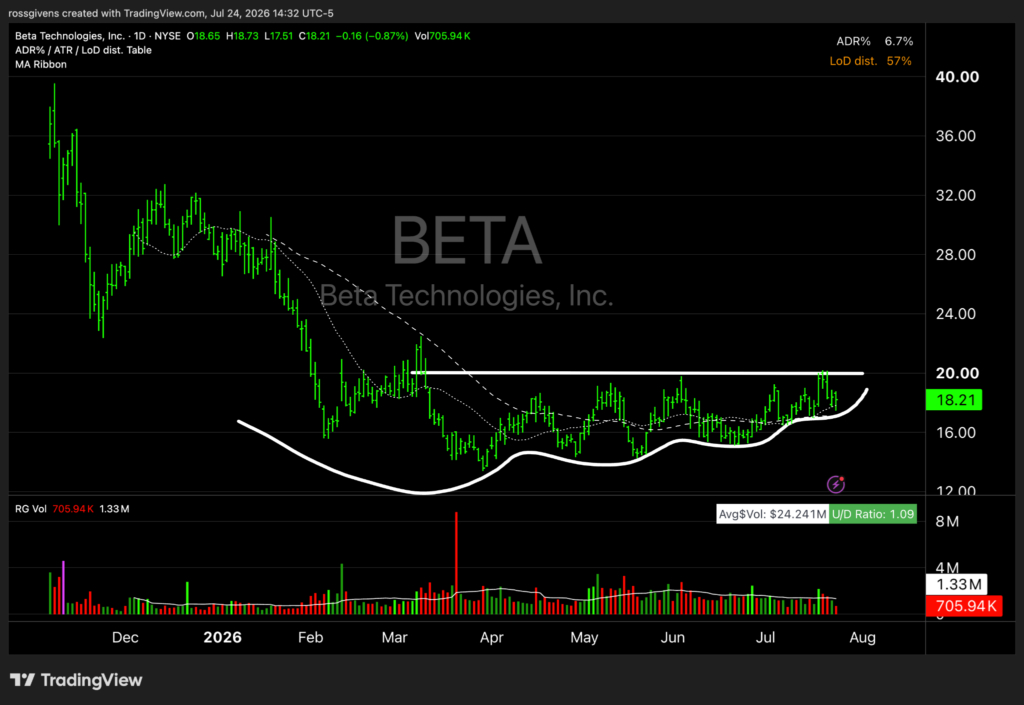
BETA went public on November 5th and, like most IPOs, quickly fell by more than half.
This happens most of the time. Stocks hit the market at ludicrous valuations, price discovery takes them down, until eventually shares reach a fair value and investors start buying – classic stage analysis.
Take a look at the chart:
BETA spent the last five months quietly consolidating near its lows. Dips are shallowing, the moving averages are turning up, and there is clear resistance around $20 a share.
Fundamentally, there’s not much there yet. Revenue is minimal and profits are non-existent. So, it is still a “story stock” priced on assumptions of future success.
But given the situation in Iran, the likelihood this thing drags on longer than expected, and the administration’s goal of increasing America’s military budget by 50%, the defense sector is not one to sleep on.
If BETA breaks out above $20/share, it would make a compelling buy for me.
Good evening, and welcome to this week’s edition of Stealth Trades!
Three weeks ago, I told you I was watching the sectors closely to see where money rotated next.
I think I found it.
If you have been with me through this AI bull market, you know the pattern by now. The money never sits still. It rotates from one theme to the next, always hunting the next bottleneck in the global AI build-out.
First, it was the semiconductors – Nvidia, AMD, Broadcom.
Then nuclear and power. Remember the runs in OKLO and SMR?
Then came the infrastructure names – data centers, cooling, power equipment.
And most recently, memory and storage – Micron, Sandisk, and Seagate going vertical, some up 1,000%+.
Every rotation followed the same logic. The market finds the next choke point in the AI expansion, capital floods in, and the stocks go parabolic before most investors even know the theme exists.
So where does the money go next?
I believe the answer is robotics. This is the next logical layer – “physical AI.”
Here’s the simple version of the thesis…
Until now, AI has been trapped in the digital world. It writes emails. It writes code. It builds spreadsheets and slide decks. Impressive stuff – but it all happens behind a screen.
That is changing right now. AI is getting a body. And the money is starting to move.
THE CATALYSTS ARE STACKING UP
Look at what has happened in just the last six weeks:
June 24 – Agility Robotics, the company whose Digit humanoid is already working in real warehouses, announced it is going public through a $2.5 billion SPAC merger with Churchill Capital Corp XI (ticker CCXI, becoming AGLT). It will be the first pure-play humanoid robot company on a US exchange.
July 3 – Chinese regulators approved Unitree Robotics’ $618 million IPO in Shanghai. Unitree reportedly did about $235 million in 2025 revenue – up 335% year-over-year – with gross margins near 60%. And unlike most of this space, it is already profitable. Humanoids are now over half its revenue.
Tesla – The last Model S rolled off the Fremont line in May. That line is being converted to build the Optimus V3 humanoid, with production slated to begin in the next few weeks. Musk’s stated ambition is an eventual 1 million units per year.
Figure AI – The startup raised over $1 billion at a $39 billion valuation to build humanoids for commercial labor. That’s a bigger valuation than many S&P 500 companies.
Amazon – Now has over 1 million robots working in its warehouses. Robots are on pace to outnumber human workers in its fulfillment centers.
Nvidia – Jensen Huang opened the year at CES declaring that the “ChatGPT moment for physical AI” is coming. Nvidia is pouring resources into its Isaac GR00T robot brains and Jetson Thor robot computers and has called robotics a $40 trillion opportunity.
Morgan Stanley projects humanoid robots will become a $5 trillion annual market by 2050, with 1 billion units deployed.
Now, I take 25-year forecasts with a big grain of salt. Nobody can model 2050.
But even if they are off by 80%, that is still a trillion-dollar market being built from almost nothing today.
THE SMART MONEY IS ALREADY MOVING
Here is the part most investors have missed. While everyone was staring at the memory stocks, the robot supply chain quietly started going vertical.
Vishay Precision Group (VPG), which makes the strain gauges and force sensors that let a robot feel pressure in its joints, ran 269%.
Teradyne (TER) – the parent company of Universal Robots that tests the AI chips going into robots is up 139% this year.
Ouster (OUST) has more than doubled as investors scramble for exposure to their digital lidar – the eyes of the machines.
Nvidia, on the other hand, has gone nowhere – up less than 5% on the year.
And this is typical of what we see early in a rotation. The picks-and-shovels names move first, quietly, while the headlines are still focused on the last theme. It is the same pattern we saw in memory a year ago.
FOLLOW THE BOTTLENECK
Regular readers know my favorite question in this AI cycle: where is the next bottleneck?
For robotics, the answer is the hardware itself.
Actuators – the motorized joints that make a robot move – are 40-60% of the cost of a humanoid. The precision gears inside them come from a tiny handful of suppliers, mostly in Japan. The high-torque motors require rare-earth magnets. Even precision ball bearings, which I’m learning is a fairly niche market, are expected to see explosive demand growth.
This is an area I will be focusing heavily on in the third quarter. And I will keep you updated on what I find.