Weekly Update: It’s Time to Buy Gold

Good evening, and welcome to this week’s edition of Stealth Trades!

The case for gold and silver just keeps getting stronger…

The global money supply surged $13.6 trillion year-over-year. That’s a 10.4% increase in a single year, to a record $144 trillion.

That makes $44 trillion dollars created, just since 2020.

Outside of wartime or severe crises, money creation has never happened this fast.

And that has huge ramifications for the prices of gold, silver, even platinum and palladium.

My job is to keep you ahead of major investment opportunities; to make sure you get in early.

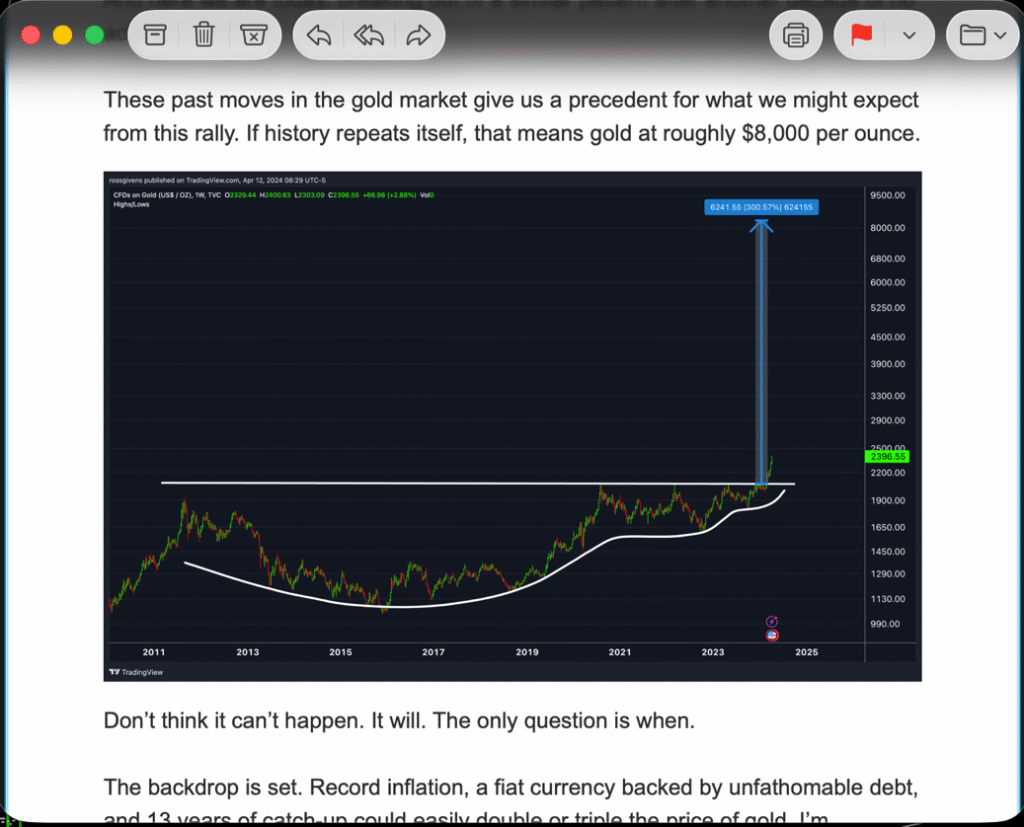
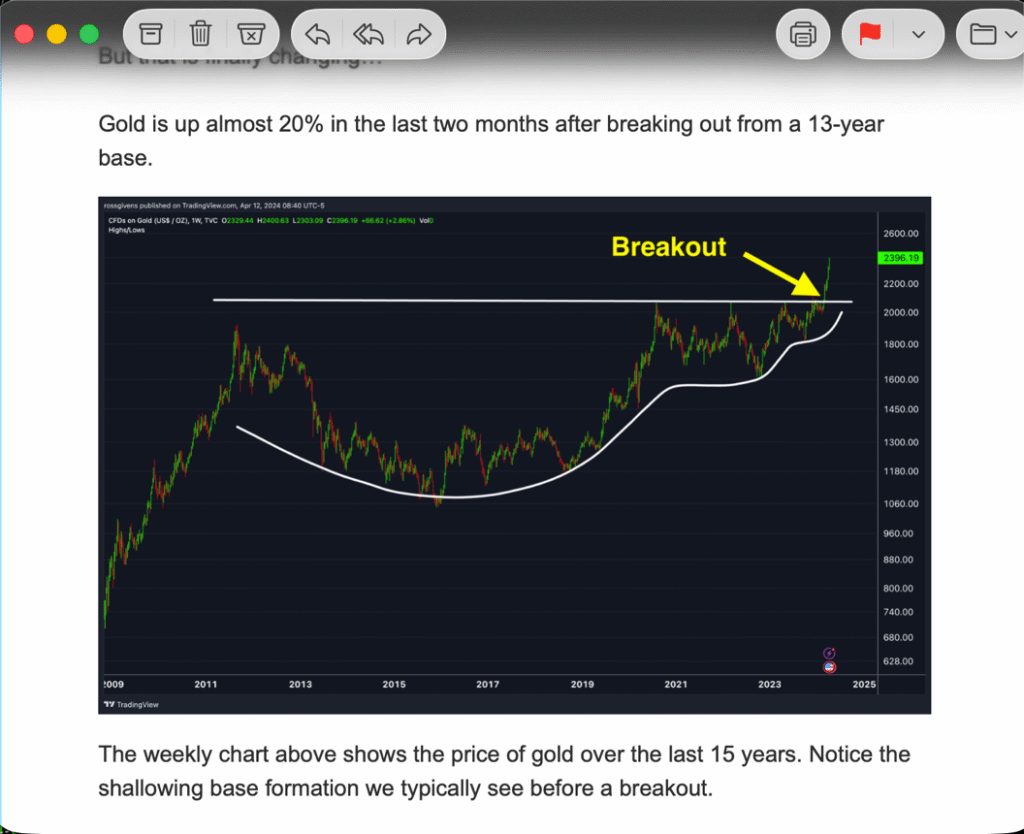
I alerted readers to buy gold almost 2 years ago when it first crossed $2,000 an ounce.

I spotted the multi-year breakout pattern and gave a price target of $8,000 an ounce.

Nothing has changed in the last two years. In fact, the bull case for gold and silver has become exponentially stronger. 

There are three main forces driving gold and silver higher:

#1 – INFLATION

Inflation is caused by one thing and one thing only – printing money. Prices rise when more dollars are added to the system chasing the same number of goods and services.

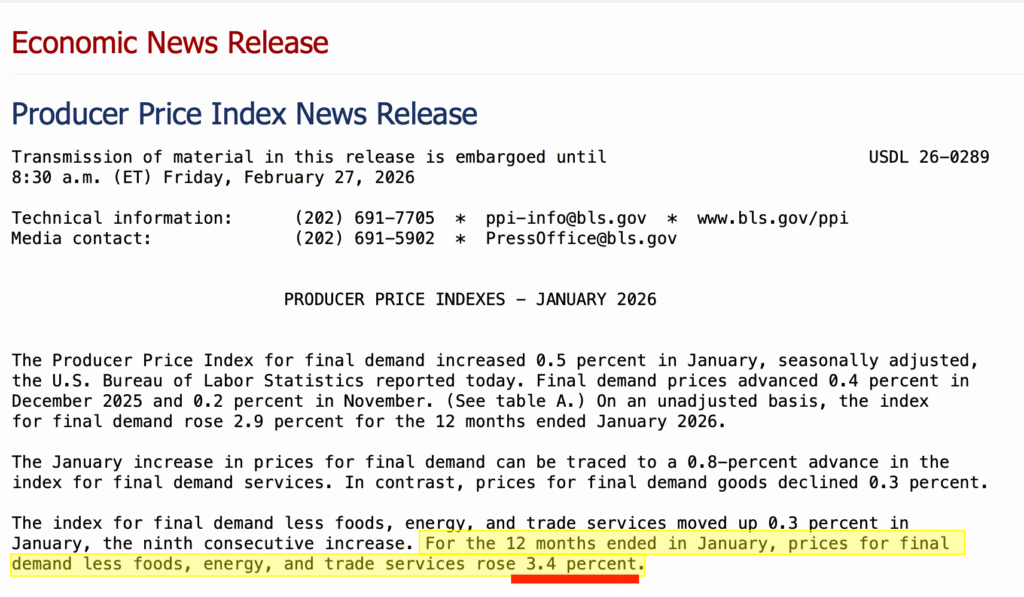
On Friday, the US Bureau of Labor Statistics released January PPI data showing higher-than-expected inflation once again.

This should come as no surprise. It’s an inevitable result of the ever-increasing money supply I mentioned earlier.

Global money supply was $26 trillion in the year 2000. It’s $144 trillion today. 

The money in existence has grown more than 5-fold in two and a half decades, and it continues to surge even in some of the best economic conditions.

Meanwhile, U.S. debt is over $38 trillion.

Interest payments have tripled in five years.

Over $1 trillion annually just in interest payments, and the government still has an annual deficit of $2.5 trillion dollars.

Governments have two choices when debt explodes:

  1. Default (they won’t).
  2. Inflate it away.

Inflation makes debt smaller in real terms.

And gold is the only monetary asset that has kept score for 5,000 years.

  • 1970s: Gold +2,300%.
  • 2008: +170%.
  • 2020: +40%.

If gold returned to its 1980 money supply ratio, it would imply $9,700 gold today.

If money grows 5% annually, models point toward $13,000 by 2050.

If money grows 7%?

Long-term models stretch toward $25,000 an ounce.

Crazy enough, there are options trades floating out there betting on $20,000 gold.

I’m not saying that happens tomorrow.

But the math makes sense.

#2 The Technical Picture

Gold has been steadily trending higher since early 2024. 

Last year, the average gold price was $3,400 an ounce.

Last quarter it was $4,100.

Today gold trades for $5,260. And this is only the beginning…

Goldman Sachs just raised their 2026 forecast to $5,400.

JP Morgan’s base case is $6,300.

Their bull case? $8,000 to $12,000 an ounce.

On the daily chart below, you’ll notice gold emerging from a shallowing consolidation pattern – almost identical to what we saw in December and before every major rally in the last two years.

From a technical perspective, this appears to be a great place to add gold and/or silver.

#3 Increase in Demand

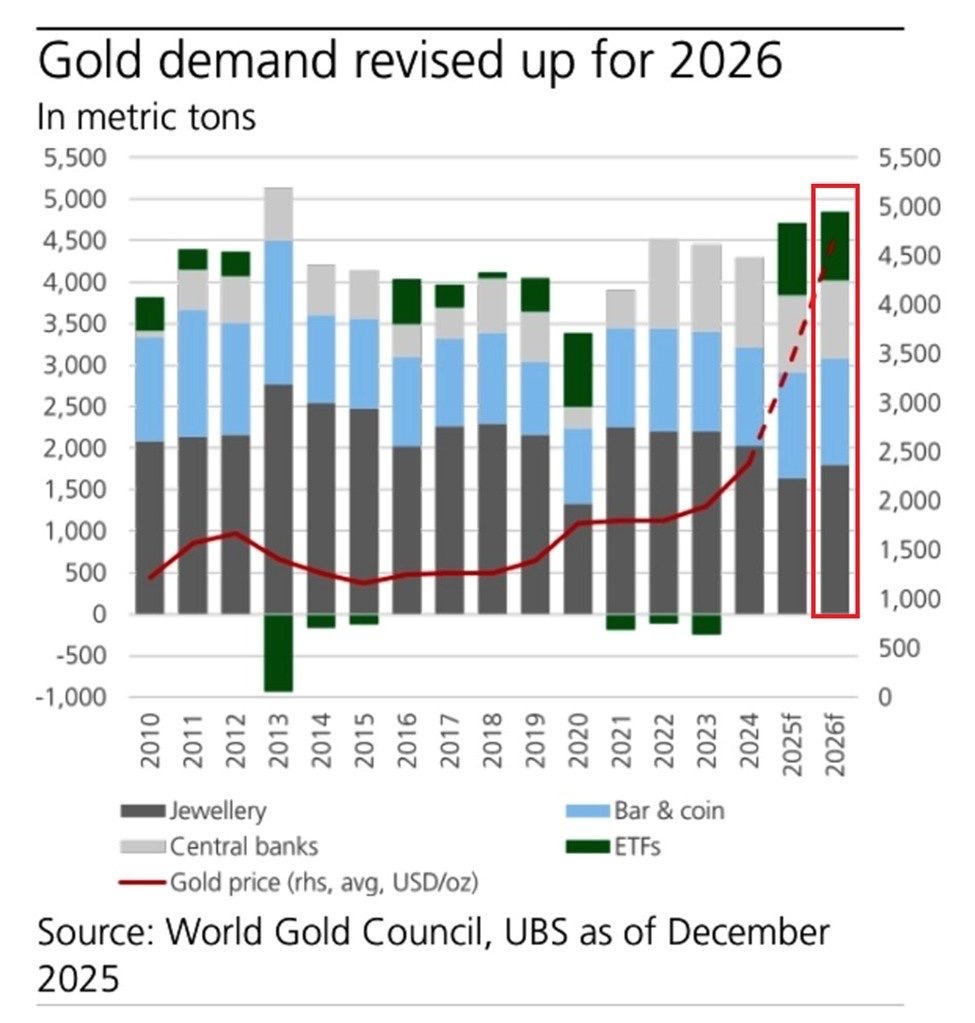
And finally, we are witnessing record demand.

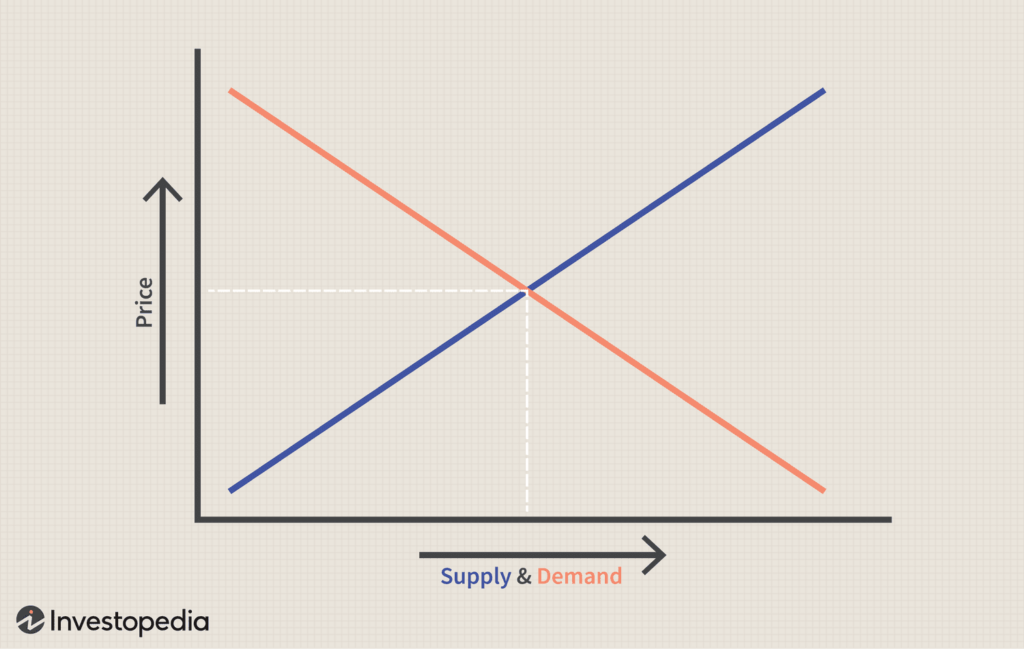
All markets, whether we’re talking about stocks, housing, or rare Pokémon cards function on the principles of supply and demand.

When demand exceeds supply – when there are more people trying to buy something than sell it – prices go up.

This is a basic economic law that has been true since the beginning of time.

And right now, that is the exact situation we find ourselves in.

Demand for gold and silver are near the highest ever recorded.

Central bank purchases have quintupled since 2022, and they’re expected to buy another 1,000 metric tonnes of gold in 2026.

Jewelry demand is estimated at 1,700 tonnes.

And physical-backed gold ETFs, which are seeing record inflows, are set to record 900 tonnes of purchases for the second consecutive year.

That is not even including regular folks like you and me who buy a steady 1,300 tonnes annually and climbing.

China bought gold every single month in 2025.

Goldman Sachs calls this a “structural shift.”

And 95% of central banks expect global gold holdings to increase.

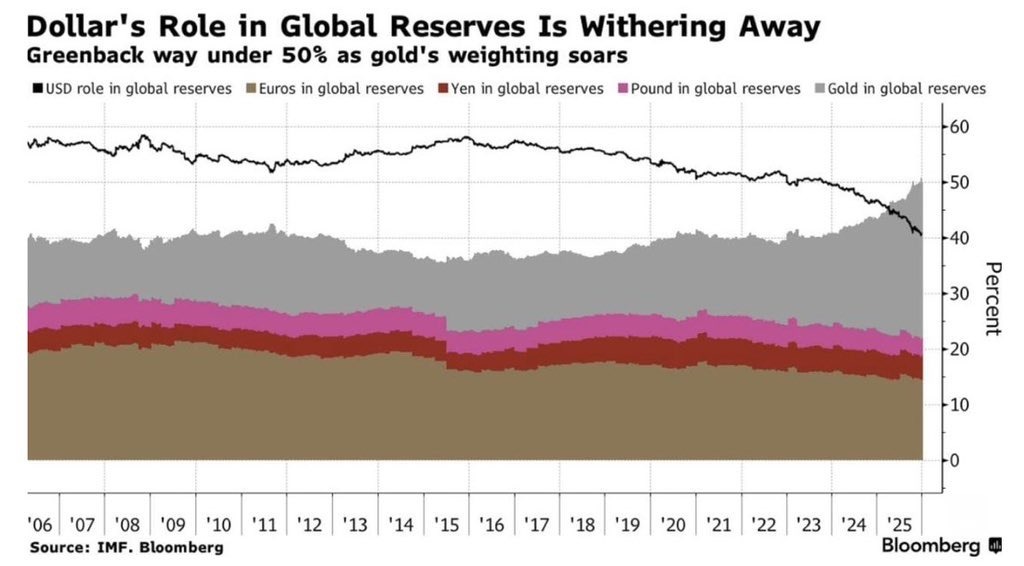
What we are witnessing is de-dollarization on a global scale.

And here’s the wild part…

Despite gold’s biggest rally in half a century, average portfolio allocation to gold is less than 1% globally.

Morgan Stanley recommends 15–20%.

When I was at JP Morgan, I always recommended at least 5–10%.

But retail barely owns it.

If portfolios shifted just half a percentage point more, JP Morgan models gold at $6,000.

At 5%? 10%? We’d easily be pushing $10,000 an ounce.

Now let’s talk silver…

COMEX silver inventory sits at ~82 million ounces.

That’s 75% lower than 2020.

In one week, 47 million ounces were claimed for delivery.

That’s over HALF of total inventory.

Silver has been running supply deficits since 2021.

Total deficit? ~800 million ounces.

That’s nearly an entire year of global production missing.

Industrial buyers used to hold 3–4 months of supply.

Now?

About one month.

AI chips… solar panels… batteries…

Industrial demand is not slowing.

And unlike gold — silver has a true industrial squeeze.

So, here’s the macro picture. We have:

  • $144 trillion global money supply and growing
  • $44 trillion printed since 2020
  • Central banks hoarding physical gold
  • 4,900 metric tonnes of annual demand
  • Silver inventories down 75%
  • 800-million-ounce supply deficit
  • Global retail allocation under 1%

Look, the January 30 dip in metals prices was painful. I get it.

But that’s all it was – a dip.

And dips, if you’re playing the long game, are a gift.

Many of the same people who sold silver when it fell to $75 will be back buying at $175.

It happens every time.

Nothing goes straight up. Prices need to correct, absorb sellers, and consolidate before starting their next run higher.

That’s where we are today.

And that’s why I believe this is the time to buy.

Best wishes for your trading,

Weekly Update: The AI Trade Is Over… For Now

Good evening, and welcome to this week’s edition of Stealth Trades!

For the last three years, investors have been focused on one thing – artificial intelligence.

Nvidia (NVDA) was the Wall Street darling and primary beneficiary of trillions in new AI spending.

Real estate investment trusts who owned data centers also did well. So did the companies who built the wiring, software and infrastructure that supports it.

But that is now what we call a “crowded trade.” Everyone is knee deep in AI stocks. And Wall Street is getting out.

The last 90 days has been a rotational period for the markets. All this means is that money managers are selling some groups of stocks and rotating into others.

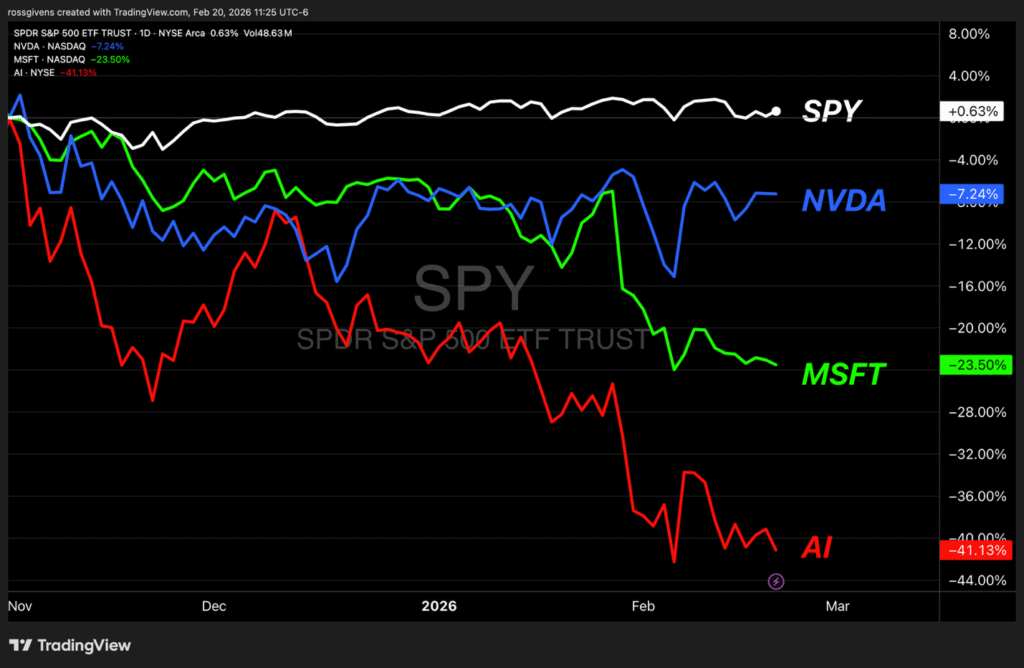
Below is the 3-month performance of the S&P 500 against Nvidia, Microsoft and C3.ai – three of the leading stocks of the AI market.

The picture is crystal clear.

The AI trade is over.

I expect to see these former leaders go even lower in 2026. That, afterall, is the historic precedent for new technologies.

Hype and optimism drive leading stocks to unreasonable valuations. They trade for prices that reflect perfect execution and exponential growth.

Put simply, the stocks go up too much too fast.

Then they come back to reality. Profit taking and institutional rotation drive prices lower, and they fall until prices are reached that reflect a discount to true value.

Dario Amodei is the CEO of Anthropic – the company behind the popular Claude AI model. In a recent interview, he laid out the single biggest financial risk in AI right now.​

It’s not whether the technology works. He’s pretty confident it will. The risk he sees is whether the money comes back fast enough to justify what’s being spent.​

He laid it out like this…

Anthropic has been growing at roughly 10x per year.​ They went from about $1 billion in early 2025 to around $9 billion by end of 2025 to $14 billion annualized as of February 2026.

That growth is insane.

But he can’t just assume it keeps going at that pace forever.

If revenue keeps growing 10x a year it would hit $100 billion by the end of 2026 and $1 trillion by the end of 2027.​

If he bought a trillion dollars’ worth of computers based on that assumption and revenue came in at even $800 billion instead, there is no hedge on earth that saves him from bankruptcy.​

Being off by just 20% when you’ve committed that much capital is fatal.

If the growth rate slows to 5x instead of 10x, or the timeline shifts by just one year – same result.​

You’re basically done.

Even if AI becomes genius level in the lab, turning that into actual revenue takes time.

Amodei uses the example of disease….

AI might discover cures for everything, but you still have to manufacture the drug, run clinical trials, get regulatory approval and distribute it globally.

COVID vaccines took a year and a half to reach everyone even with the entire world in a panic.

Polio has had a vaccine for 50 years and still hasn’t been fully eradicated.​

The technology being ready and the revenue actually showing up are two very different timelines.

So, what does he do?

He deliberately under buys.​ He commits to hundreds of billions in infrastructure, not trillions.

He accepts the risk that if demand explodes, he won’t have enough capacity.

Because he’d rather leave money on the table than bet the entire company on a growth curve that might be off by a year.

But not every tech company is showing the same restraint…

Some of the other AI companies are just throwing money around without doing the math. Committing $100 billion here, $100 billion there, without actually modeling what happens if revenue comes in below expectations.​

He calls it YOLOing – a term us traders are familiar with.

For context, Big Tech is expected to spend around $625 billion on AI infrastructure in 2026 alone.​

AI services are only generating about $25 billion in actual revenue against all of that.​

That’s roughly a 4% return on what’s being invested.

The gap between what’s being spent and what’s being earned right now is massive. And therein lies the problem.

This is the same dynamic that wiped out dotcom companies in the early 2000s.

They built the infrastructure for demand that eventually came, but it came too late to save many of the companies that built it.​

Today’s stock prices – the valuations of these hot young AI companies – are out of touch with reality. They reflect years of future growth that has not yet happened.

OpenAI, for example, did $20 billion in revenue last year. Yet it has $1.4 TRILLION in spending commitments.

The math isn’t mathing.

He thinks his company is too big to fail. He’s wrong. It will.

Others will end up being the best investments of all time. But only when the price makes sense.

In all likelihood, they will see a correction first.

And when that happens, I’ll be looking to buy; to make long term investments in what will be massively successful companies over the next 10-20 years.

In the meantime, my advice is to avoid too much exposure to AI in your investment accounts. 

Most index funds which are market cap weighted. Big companies like Nvidia and Microsoft get a disproportionally large chunk of your investment dollars.

They can suffer big losses if the top 5 or 10 stocks fall off.

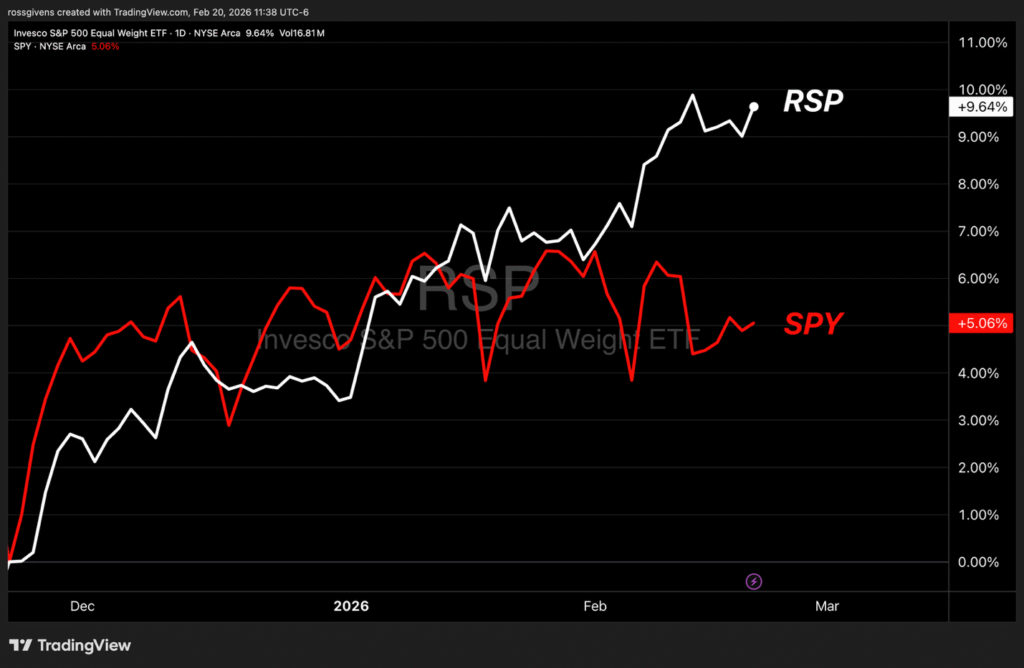
A simple way to avoid this is with an equally weighted fund like RSP. RSP is the Invesco S&P 500 Equal Weight ETF. All 500 stocks in the index are given the same weight.

Over the last 90 days, RSP has delivered nearly doubled the returns of SPY.  

It continues to make new highs, even though Microsoft, Amazon and Apple are in free fall.

In Monday morning’s live session, we will do a deeper dive into the leading areas of the market to identify where money is flowing and hopefully identify some new opportunities.

I’ll see you then.

Best wishes for your trading,

Ross Givens

Weekly Update: BlackRock’s Big Energy Trade

Good evening, and welcome to this week’s edition of Stealth Trades!

Hedge funds are betting big on AI. But they’re not buying Nvidia anymore. Their latest investments have nothing to do with chips at all.

Wall Street funds have shifted their focus. They’re not buying tech startups anymore; they’re buying the power that keeps AI alive.

Blackrock ,Blackstone and dozens of others are going beast mode on utilities.

Now, these companies have, historically, been pretty boring. But not anymore. In fact, they could be some of the biggest winners over the next few years…

BlackRock just acquired Minnesota Power for $6.2 billion.

Blackstone is dropping $11.5 billion on TXNM Energy.

And this is just the tip of the iceberg.

Today I’m going to lay out why energy is Wall Street’s trade of the year. I’m also going to share three stocks you can buy today to get in on the action.

Last year, BlackRock acquired Global Infrastructure Partners (GIP) for $12.5 billion. This expanded the fund’s energy footprint to create a $170 billion dollar infrastructure powerhouse.

GIP now operates as a division of BlackRock, strategically targeting high-growth areas like digital infrastructure, energy, and transportation.

BlackRock didn’t even have the money to buy it. They had to issue 12 million new stock shares to buy it. They diluted their shareholders… that’s how badly they wanted this deal.

They spent $500 million for a 20% equity stake in Recurrent Energy – a cutting-edge solar company spun off from Canadian Solar.

Before that they bought that natural gas giant, Vanguard Renewables – all of it- along with Jupiter Power, Akaysha Energy, and New Zealand-based solarZero.

And that’s just on the renewable side…

Blackrock is buying up utility companies and grid infrastructure hand over fist.

A few months ago, it acquired Allete, which owns Minnesota Power and Wisconsin’s Superior Water, Light & Power for a cool $6 billion.

They teamed up with Morgan Stanley to pick up a stake in Portland’s pipeline business via TC Energy.

Two weeks ago, BlackRock increased its stake in California utility operator, PG&E .

And it continues to add to its holdings in NextEra Energy, ticker NEE, as well. The stock just hit its all-time high.

I haven’t even mentioned their legacy holdings in Exxon, Chevron and Diversified Energy. Or their new partnership with Microsoft set to invest another $30 billion in AI data centers and the energy infrastructure that powers them.

BlackRock is on a buying spree. They’re spending like a teenager who just got her first credit card.

This is Wall Street’s next gold rush. And this time, it’s not apps, chips or data. It’s energy.

Artificial intelligence is seeing rapid adoption. Even if you’re trying not to use it, you probably are. AI is embedded in search engines, trading algorithms, even your smartphone.

But behind the optimistic headlines is a silent emergency. The AI boom is consuming power faster than our electrical grid can possibly keep up.

Today, U.S. data centers consume 5% of all electricity generated. And over the next three years, that number is expected to double.

Data centers are the new factories of this digital age — massive, relentless, and always on. They hum day and night, processing trillions of computations per second.

But there’s just not enough juice.

Every single AI model, every image generation, every chatbot reply — it all burns electricity.

A single AI data center can consume as much power as 150,000 homes. And there are 5,427 of them operating right now, 24/7/365.

Energy isn’t just a line item anymore — it’s a pressure point. And those who control will wield enormous power over the industry.

We taught machines to think… but forgot how to keep the lights on.

So, while amateurs argue over who has the best language model, the real billion-dollar play is who controls the grid.

BlackRock knows it. Blackstone knows it. They’re not chasing the next OpenAI… They’re chasing the power OpenAI needs to survive.

Because AI isn’t just software anymore. It’s infrastructure. And infrastructure runs on electricity.

The AI boom has flipped Wall Street’s logic. Historically, it has invested in innovation. But today, it is investing in what innovation consumes.

Every ChatGPT query, every GPU cluster, every AI-generated image of a cat playing the violin, it all burns megawatts.

The smart money is moving fast. They’re not betting on AI startups. They’re buying the power plants that fuel them.

To put it simply… AI made energy the new gold. And this is just the beginning.

Wall Street is getting in early. Here are 3 stocks being bought heavily by institutional investors.

NextEra Energy (NEE)

NextEra is currently undergoing a strategic transformation from a traditional defensive utility into a critical infrastructure provider for the AI era. The company is leveraging its massive renewable energy backlog and nuclear assets to secure long-term contracts with hyperscalers – including a 25-year power purchase agreement with Google for electricity from its Duane Arnold nuclear plant.

NextEra is also expanding its natural gas assets. Last month, the company increased its stake in  Mountain Valley Pipeline.

Its acquisition of Energy Capital Partners is expected to close this quarter, which will expand the company’s customer supply business across 34 states.

Dominion Energy (D)

Dominion is a primary play for AI growth thanks to its position as the power provider for “Data Center Alley” in North Virginia.

The company already has a foothold with the major players and stands to benefit as they continue to expand. Dominion is executing a $50 billion capital investment plan over the next five-years targeting a projected 183% increase in energy demand in the area.

They are also in a $500 million joint venture with Amazon to develop a 300-megawatt modular reactor near the North Anna nuclear plant.

Talon Energy (TLN)

Talon is betting big on nuclear, which many believe will be the future of domestic energy production.

In June, the company expanded its relationship with Amazon Web Services through a new power purchase agreement to provide 1,920 megawatts of carbon-free nuclear power through 2042. That power will be fed straight into Amazon’s data center campus adjacent to Talen’s Susquehanna nuclear plant.

Price hedges ate into its bottom line in 2025. But as these hedges roll off, management expects to collect higher prices on 40% of its production this year and 75% by 2027. Plus, unlike variable renewable sources, Talen’s high-volume generation platform provides the reliable, continuous supply required by data centers.

The AI revolution won’t be won by who codes best, but by who controls the electricity.

It doesn’t matter how good your competitor’s model is. If you control the grid, he can’t run it.

Best wishes for your trading,

Weekly Update: AI Is Out. Metals and Energy Are In

Good evening, and welcome to this week’s edition of Stealth Trades!

The AI trade, which has been the dominant since the 2022 lows, is quickly fading.

Stocks that soared for most of this bull market are coming down across the board.

Nvidia, Microsoft, Palantir… these were some of the biggest winners over the last few years.

But they are no longer leading the market.

Below is the peak to trough drawdowns of some of the biggest tech names over the last few months:

  • Palantir (PLTR): -36%
  • AMD (AMD): -27%
  • Microsoft (MSFT): -27%
  • Broadcom (AVGO): -25%
  • Tesla (TSLA): -20%
  • Nvidia (NVDA): -18%
  • Meta (META): -17%

Yet, despite weakness in the Magnificent 7, the S&P 500 is within 1% of new all-time highs.

How is this possible?

One word… rotation.

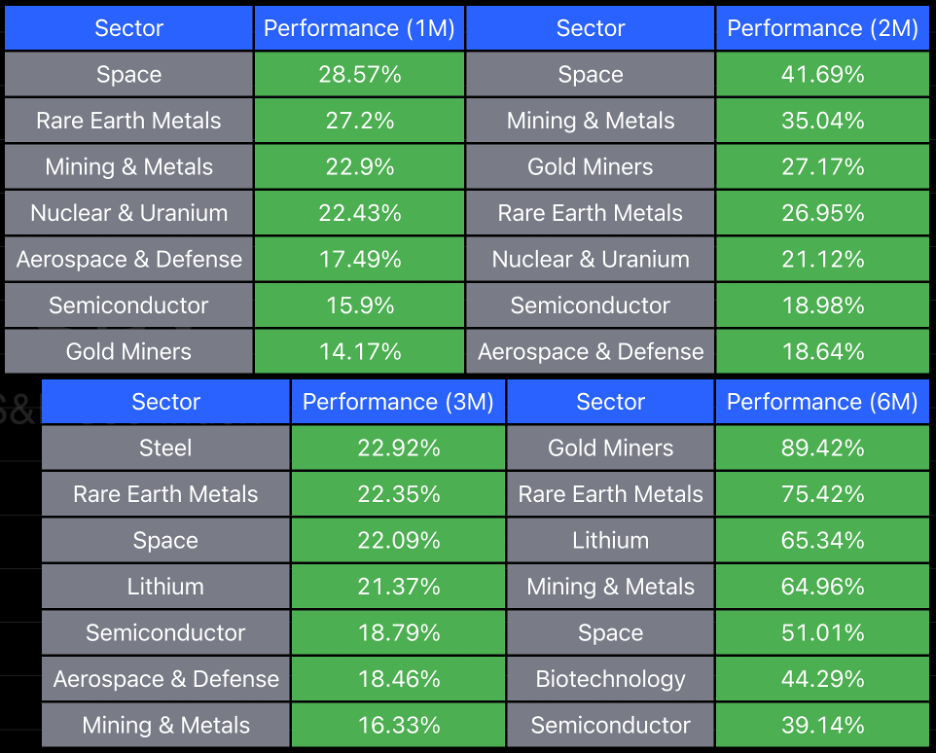
Wall Street is moving its capital – out of high P/E tech names and into mining and metals companies.

Gold and silver miners are on fire. Rare earths are booming as well.

Silver, although it saw a nasty correction last week after running up too far too fast, is still up 36% since December.

The energy sector (think oil, gas and utilities) is the best performing area of the market over the last 30 days. I can’t remember the last time that was the case.

This is a major leadership shift.

One glance at our Industry Strength tables and the picture is crystal clear.

Tech is out of favor…. at least for the time being.

The “smart money” is piling into physical assets and the companies who get those assets out of the ground.

A look at the major indexes further enforces this point.

The tech-heavy Nasdaq is trading at its lowest level in 2 months.

The S&P is somewhere in the middle.

And the Dow Jones INDUSTRIAL Index is making new all-time highs.

Eventually, things will change. But right now, this is where investors should be focused.

Best wishes for your trading,

Weekly Update: Gold, Silver… Now Copper?

Good evening, and welcome to this week’s edition of Stealth Trades!

There is a metal shortage that no amount of money can fix quickly — and the companies that see it early are already locking up supply.

Amazon just bought an entire mine.

And this is creating a huge opportunity for investors who get in early. Today I’m going to break down this opportunity and give you my top 3 stocks to take advantage of.

When the metals markets move, they move hard and fast. Prices can lie dormant for decades before exploding higher.

Gold went nowhere for more than a decade. Then last year it took off like a rocket – surging 60% and blasting through all-time highs.

The big winner was, and continues to be silver, however. Silver prices are up 300% in less than two years, breaking through $100 an ounce today.

If you’re a longtime subscriber, you probably own some of both. My newsletters and YouTube videos recommended buying gold at $2200, silver at $40, even palladium before its run.

But if you missed out on the rally in precious metals, don’t fret. Because there’s an all new metal trade setting up right now.

I’m not selling my gold and silver, but the smart money is rotating into a new opportunity right now.

What they’re buying today is the metal that actually powers economic growth. It is the physical backbone of the future.

They’re buying copper.

Unlike silver, copper demand is not being driven by speculative mania or retail frenzy. There is a genuine shortage.

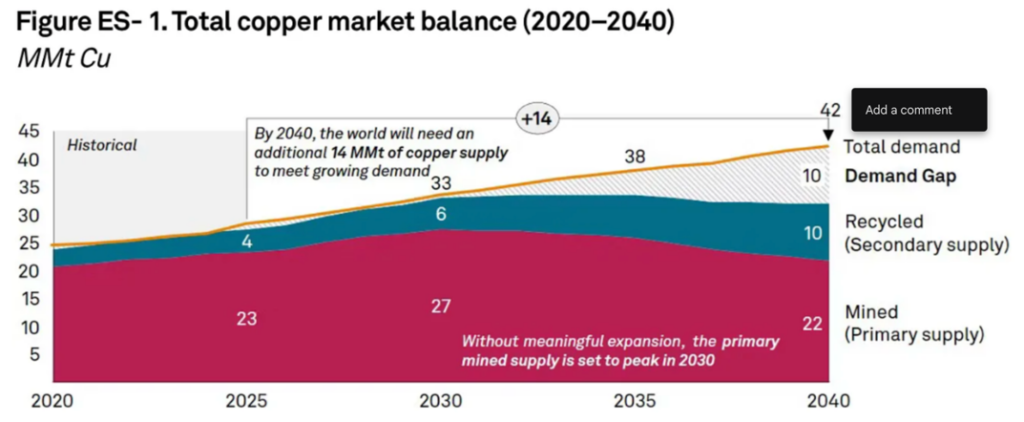
With demand exceeding supply by 10 million tons annually, the price has nowhere to go but up.

Amazon Web Services — the backbone of the modern internet — just took unprecedented action.

Instead of buying copper on the open market, Amazon signed a direct supply deal with mining giant Rio Tinto.

And here’s the crazy part…

The copper mine involved in the deal was dead. The Johnson Camp mine in Arizona hasn’t produced copper in over a decade.

Amazon is resurrecting a dead mine.

Why?

Because they don’t believe the copper they need will be available later.

Rio Tinto is restarting this mine using experimental technology called bio-leaching — using bacteria and acid to extract copper from low-grade rock that miners used to throw away.

Let that sink in.

Amazon is one of the most sophisticated logistics companies on Earth. If copper were easy to buy, they’d just buy it.

Instead, they’re bringing a mine back from the dead to lock up supply.

Big Tech sees a shortage coming — and they’re racing to secure private supply lines before the rest of the world wakes up.

I thought I’d seen it all. But when the tech nerds start turning into miners… something big is happening.

This is the modern version of a gold rush.

To fully grasp the scope of this opportunity, we also need to kill one of the most misleading metaphors of the last 20 years – “the cloud.”

There is no cloud. Your photos are not stored in the sky.

They are in massive, windowless concrete buildings packed with silicon chips that run hotter than a pizza oven.

Every time you ask AI a question, a processor spins up, draws electricity, and creates heat. To keep that chip from melting, fans roar, coolant pumps cycle, and industrial air conditioning works overtime.

All of that movement — electricity and heat — requires infrastructure. And that infrastructure is copper.

A regular Google search uses a tiny amount of power. An AI query can use 10 to 100 times more.

We’re moving from a text-based internet to a computer-based internet — and that changes things.

Because as chips get faster, they get hotter. Air cooling has reached its limit.

The next generation of data centers will rely on liquid cooling — pipes running coolant directly across chips.

And the best material on Earth for moving heat efficiently?

Copper.

Actually, it’s silver. But silver is $100/ounce ($1,600 per pound). Copper is $6 a pound.

A recent study from S&P Global estimates that AI alone could boost global copper demand by nearly 50% by 2040.

At the same time, mining output is falling behind — creating a projected 25% supply shortfall.

Amazon doesn’t just need copper for wires. They need it for transformers, busbars, heat exchangers, and cooling systems.

Aluminum isn’t good enough. It conducts less, expands more, and creates fire risk.

Fiber moves data — not power.

Copper is non-negotiable.

No copper means no data centers.

No data centers mean the AI revolution hits a wall.

Higher prices should bring higher supply. But in mining, it’s not that simple.

Today’s supply shortage was 15 years in the making.

After the last commodity crash, miners cut exploration budgets, and now we’re paying the price.

It takes 15 to 20 years to bring a major copper mine online. Even if we started ten massive projects today, they wouldn’t produce meaningful copper until the late 2030s.

Plus, existing mines are aging. The easy copper is gone. Grades that were once 5% are now 0.5%. We’re moving mountains for slivers of metal.

That’s why Rio Tinto is using bacteria.

They’re digging through the trash pile because the cupboard is bare.

By 2030, grid demand alone could reach 15 million tons of copper.

AI… EVs… grid rebuilds… all fighting over the same limited pile of red metal.

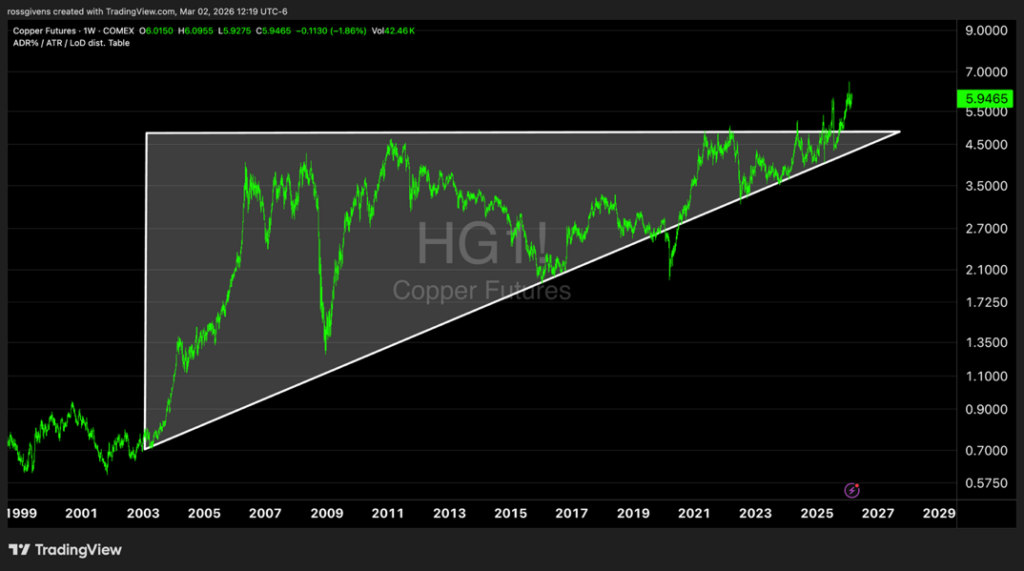
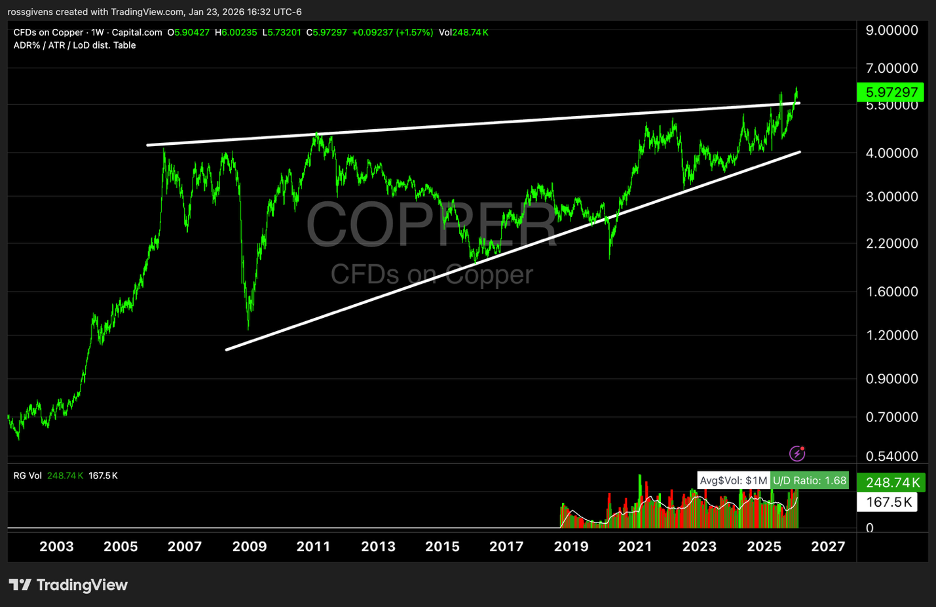
Last week, copper hit $6 per pound.

For most of the last decade, it lived between $2 and $4.

This, my friends, is a breakout…  not a top.

I admit, the chart is not perfect. But there is a clear compression that has been building for two decades…

The tough thing about buying copper is storage. At $6 per pound, a $12,000 investment would get you a metric ton of the stuff. Where are you going to store it?

You can’t.  

Instead, we play the equities. We buy stock in the companies digging the stuff out of the ground.

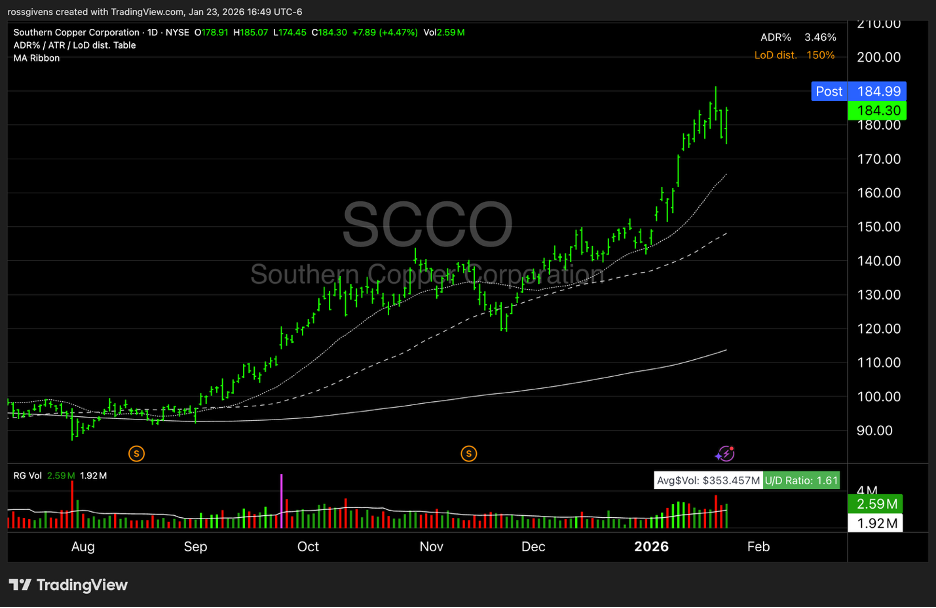
Here are my 3 favorite copper mining stocks:

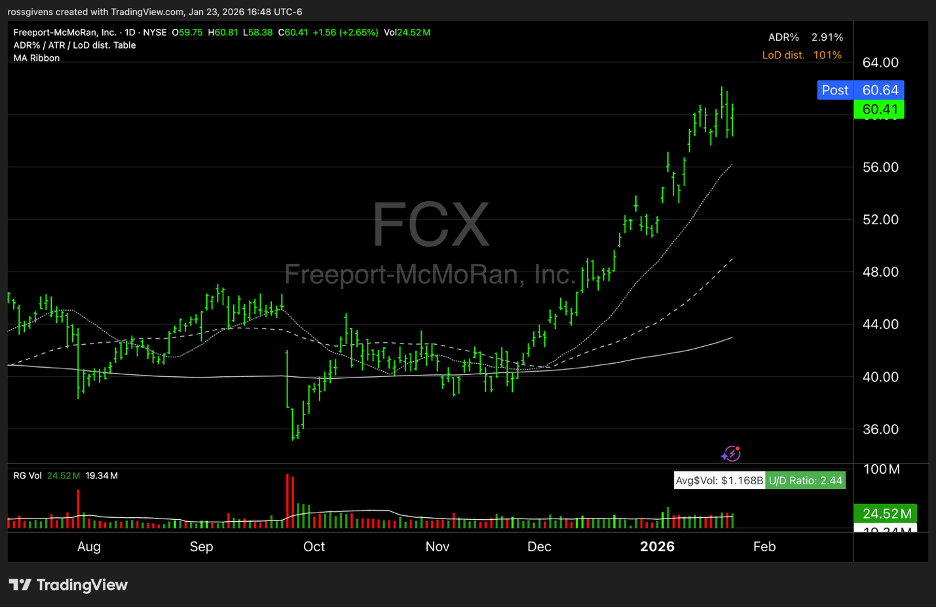
Freeport-McMoRan (FCX)

 Freeport is the largest US copper producer, working the massive Morenci mine in Arizona. This is the industry leader.

Southern Copper Corporation (SCCO)

SCCO is in the number two spot by size.

Headquartered in Phoenix, this company has significant revenue and several new projects in the pipeline.

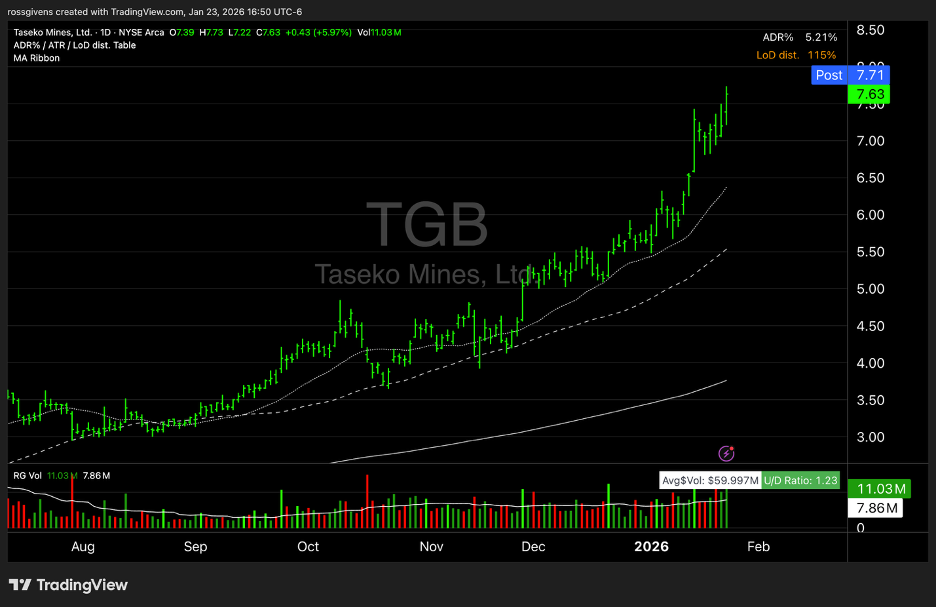
Taseko Mines (TGB)

If you’re looking for a high-risk, high-reward bet, this is the one.

Taseko is a $2 billion Canadian operator whose stock is up over 90% in 90 days with no sign of slowing down.

The company’s Florence Copper project in Arizona is nearing full operation with some of the lowest cost metrics in the industry.

Almost 100% of Taseko’s output is copper, making it one of the purest plays in this space.

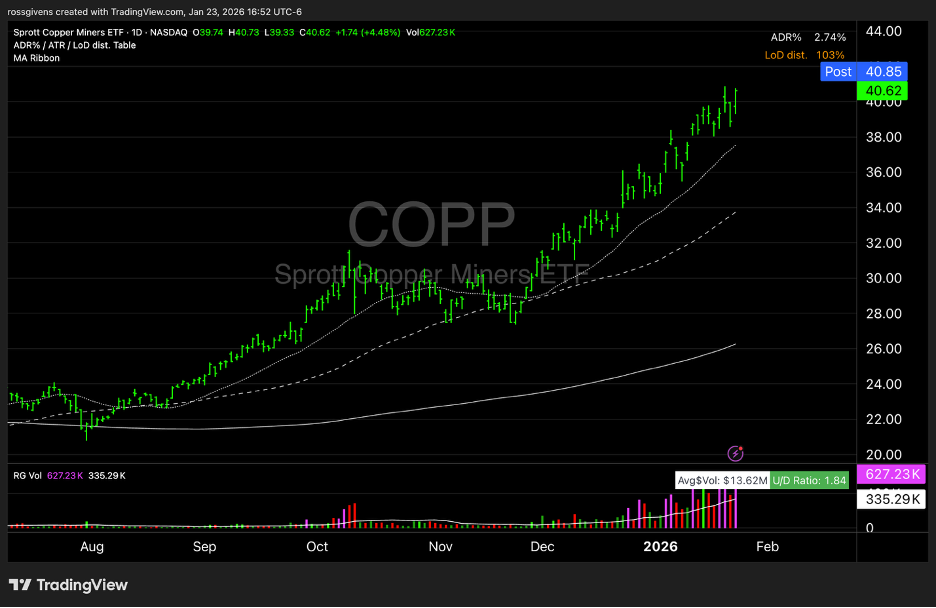
Alternatively, if you want diversification, the Sprott Copper Miners ETF (COPP) is the catch-all play.

COPP is a basket of mining stocks. It holds all 3 of these stocks along with 58 others.

Best wishes for your trading,

Weekly Update: Potential Breakout in Leading Group

Good evening, and welcome to this week’s edition of Stealth Trades!

We updated the TA Industry Strength indicator last week with a few new sector ETFs. One of them is the Procure Space ETF, ticker UFO.

And thank goodness we did.

This often-overlooked sector is the top performer over the last couple months.

Space is a “risk-on” area of the market. These stocks rise when investors are taking big risks with little fear.

This aligns with my long-term view that markets will continue higher with more liquidity being pumped in. So, the timing makes sense.

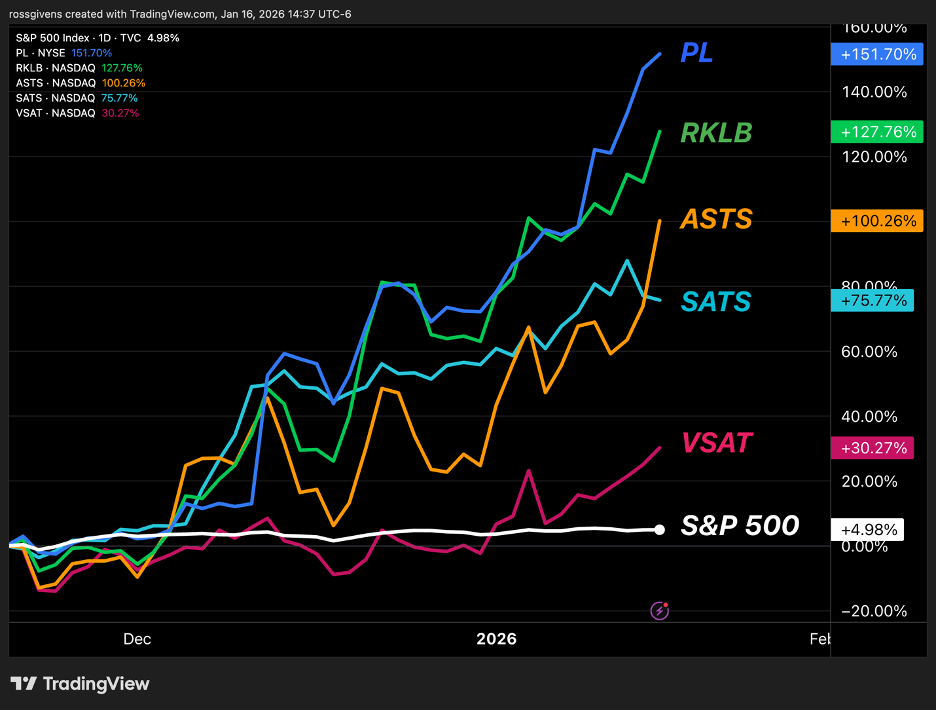
A lot of the stocks in this group are extended. Planet Labs (PL) is up 152% in the last 60 days. Rocket Lab (RKLB) and AST SpaceMobile (ASTS) have more than doubled.

The space sector is on the move. But I prefer to buy stocks coming out of consolidations – when I can get a low risk/high reward entry point.

Most space stocks don’t meet that criteria today. But one does…

Garmin’s next-generation smartwatches are used to track astronauts’ heart rate, sleep, oxygen levels and body battery during missions. This data, collected via Garmin’s health API feeds research databases used in spaceflight.

The company’s LIDAR-Lite v3 sensor measured altitude and distance to the ground on Ingenuity’s flights to Mars.

Garmin’s technology has become an integral part of space exploration and, as a result, Garmin LTD stock (GRMN) is the eighth largest holding in the space ETF.

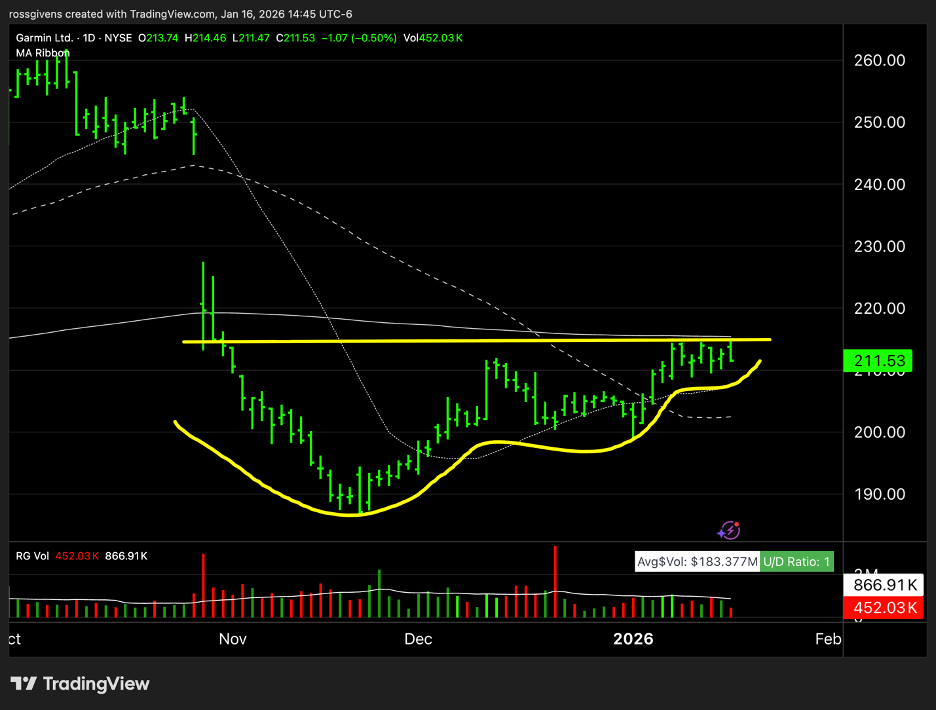
Below is a daily chart of GRMN stock…

I have outlined in yellow the shallowing base pattern forming off the lows.

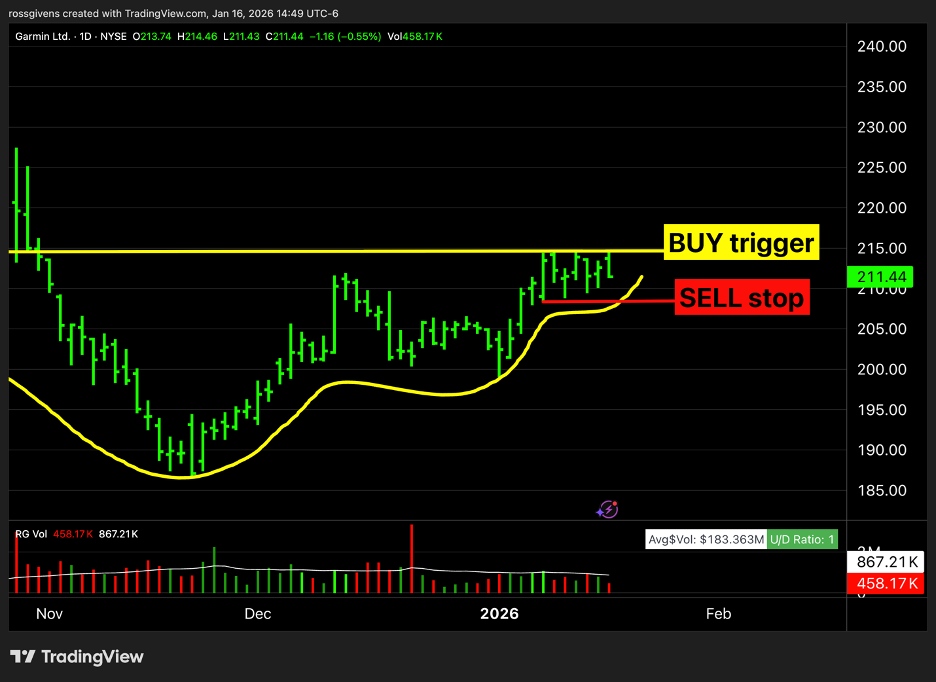
If it breaks out above $215 per share, investors might consider buying for a move back into the $240 range.

And while Garmin is unlikely to surge +100% in two months like some of the others, the risk here is minimal. Thanks to tight price action over the last two weeks, one only needs to risk 3% on the trade.

A sell stop order at $208 should be sufficient.

GRMN formed a similar pattern last year before surging 25% higher. With the tailwind of buying in space stocks, we could easily see that replicated here.

Best wishes for your trading,

Ross Givens
Weekly Update: My Option Trade on the Venezuela Situation

The Venezuela Situation has created what could be a once-in-a-decade investment opportunity. And I am taking an option trade to potentially cash in on a big move in 2026.

First, this is not a low-risk trade. Options always carry more risk in terms of percentage on capital. And this is an all-or-nothing bet that I believe has massive upside.

Like all big ideas, there is a catalyst involved. In this case, the US intervention in Venezuela.

For those who don’t know, Venezuela has the largest oil reserves in the world – even more than Saudi Arabia. And last week, US special forces black bagged the country’s president and bought him back to Manhattan to stand trial.

POTUS announced to the world, with no hesitation, that US companies would fix Venezuela’s infrastructure and start making money for the country.

And therein lies the opportunity…

You see, Venezuela doesn’t have light, sweet crude like what we have in the US. Theirs is heavy crude which requires specialized equipment to extract, transport and refine.

This equipment also requires extensive maintenance which Venezuela has neglected for two decades thanks to sanctions and generally just not caring how they treated their newly nationalized assets.

Because of this, they only drill around 2.5 million barrels a day. That pales in comparison to the 15 million barrels a day coming out of the US.

But that will soon change…

If their infrastructure gets the overhaul it needs, Venezuela could once again become a very rich country. Its citizens would be lifted out of poverty in a very short time.

And this is a bet on that outcome.

At some point this year, once the dust settles and the Maduro trial wraps up, President Trump will take the podium alongside Venezuelan and announce this massive Venezuelan infrastructure project.

Analysts believe the cost for such a project could be upwards of $250 billion dollars. And whichever company gets this massive 12-figure contract is going to see their stock price soar.

There are only 3 companies with the size, skill and expertise to pull off such a project: Haliburton (HAL), Baker Hughes BKR), and Schlumberger (SLB).

I cannot say which company will get it, or if the contract will be split between 2 or 3 of these firms.

So instead of betting it all on a single horse, I am making a parlay of sorts. I am buying long-dated call options on all three of these stocks.

Each option expires in December 2026 – giving all year to see if it plays out like expected.

Here are the specifics:

  • SLB Dec18 $55 call (approx. $300/contract)
  • HAL Dec18 $40 call (approx. $205/contract)
  • BKR Dec18 $60 call (approx. $290/contract)

These options have strike prices roughly 20% above the current stock prices. So, each stock needs to be up over 20% by year end to profit.

But, at least to me, this seems more than reasonable given the I scale of this situation.

Catalysts are huge in the investment world. Whether it’s an earnings beat, a rate cut, or positive drug trial results, these shock events are behind nearly every major market move.

And for an oil services company… What could POSSIBLY be bigger news than getting access to the largest oil reserves in the world?

I am not telling you to take the same trade. This is no way a risk-free or even a low-risk trade.

It is an all or nothing bet on a once-in-a-decade opportunity in the oil services sector. I’ll let you know how it works out.

Best wishes for your trading,

Weekly Update: We Just Got BIG News for The Stock Market

Good evening, and welcome to this week’s edition of Stealth Trades!

Inflation is getting better. The job market is getting worse.

And this combination of declining inflation and a weakening job market means we are almost guaranteed another interest rate cut in January.

Thursday morning, the US Bureau of Labor Statistics released the latest CPI number.

CPI stands for Consumer Price Index. It measures the change in prices paid by consumers for a basket of consumer goods and services.

It tracks the prices of housing, clothes, food, utilities and medical care – all the basic necessities.

And once a month, the US Bureau of Labor Statistics compiles this data and publishes the number. Inflation is how much this figure went up compared to the same month last year.

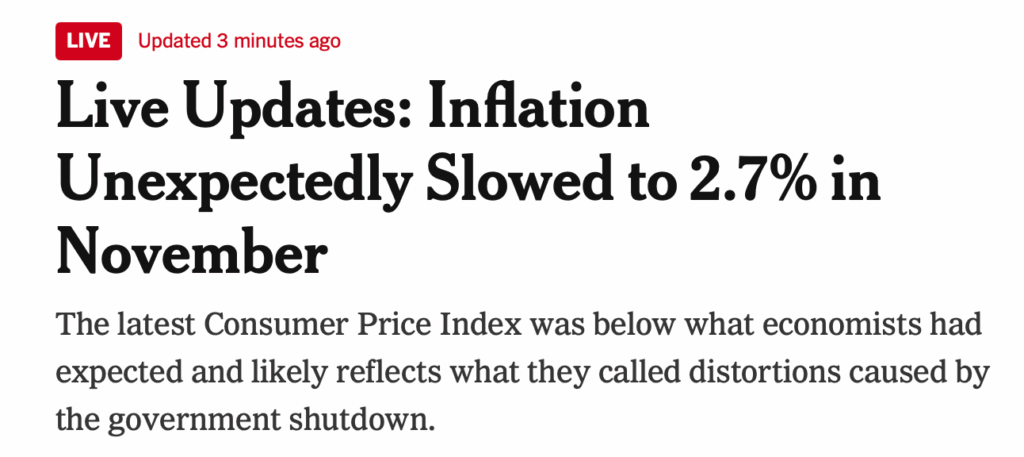
And shockingly, inflation came down in November. Prices were higher, but not by as much as they had been in previous months.

Core CPI, which is everything except food and energy prices which can be volatile, was up 2.7% year-over-year.

And while this is still above the Fed’s long-term 2% target, it is better than expected.

The August number was 3.1% – a new 6-month high.

September came in around the same at 3%.

There was no report in October due to the government shutdown, but most economists were forecasting around the same 3%.

So, 2.7% was a surprise… and a good one. But the ramifications are far bigger than saving 10 cents on beef at Piggly Wiggly.

It means the odds of a January rate cut just went way up.

Because lower-than-expected inflation isn’t the only piece of news we got this week.

On Tuesday, a new jobs report was released.

And it showed that the US labor market continues to weaken.

They released data for October and November at the same time.

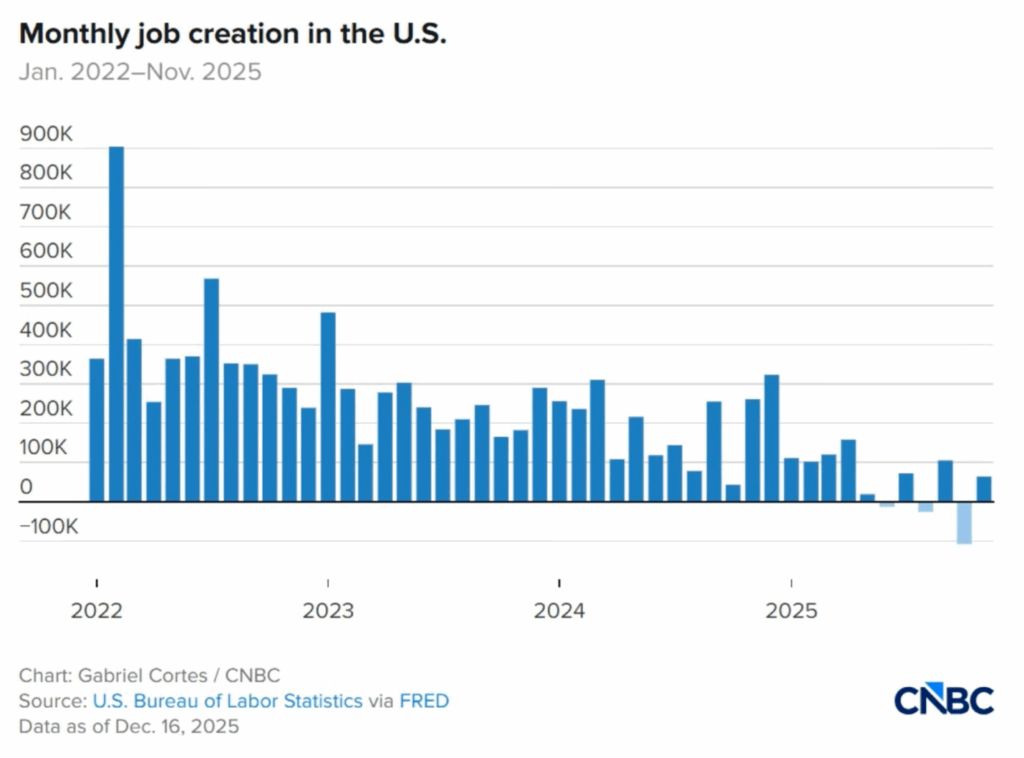
The US lost 105k jobs in October and gained 64k in November – a net DECLINE of 41k jobs.

Look at the trend over the last four years.

These are the jobs added on a monthly basis since 2022.

You don’t need to be an economist to see that the job market is in trouble. The numbers are steadily declining.

But it’s the last 6 months where things have really taken a turn for the worse.

In 3 of the last 6 months, the US economy has lost jobs. We haven’t lost people.

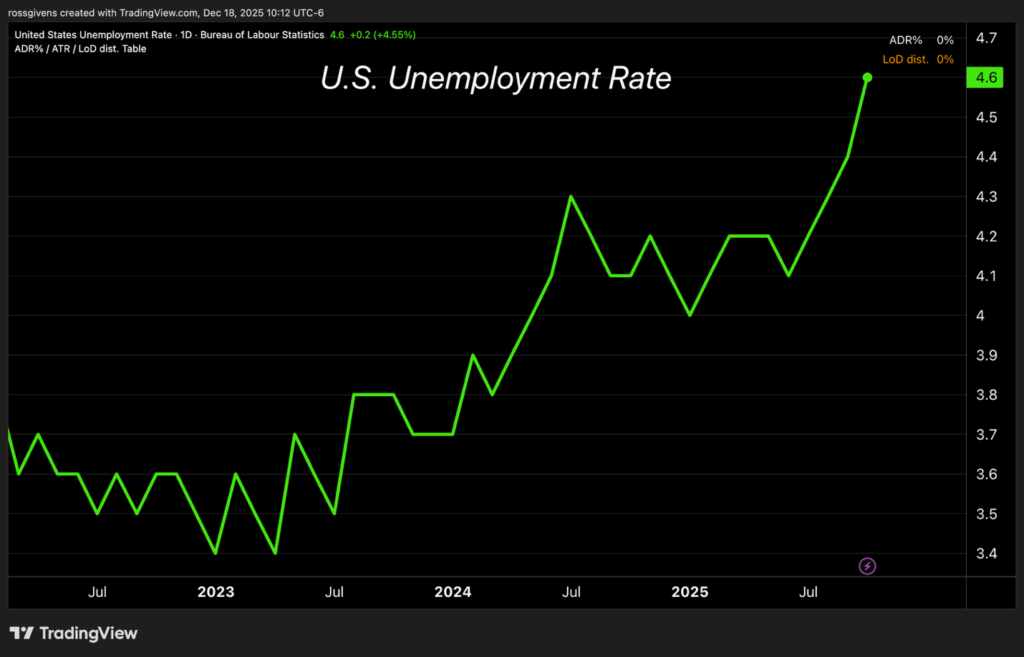
So, the unemployment rate is rising. It is at 4.6% and climbing.

Another thing to keep in mind is that these numbers are not accurate. They will most likely be revised downward and most perhaps heavily.

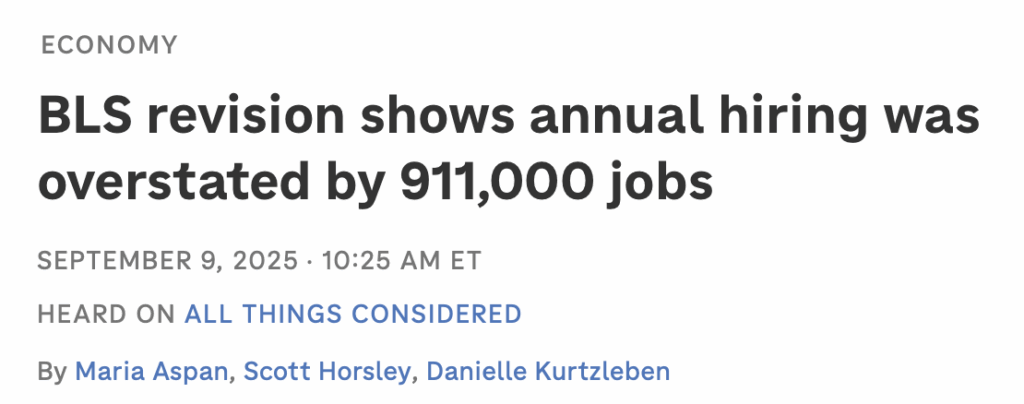
Back in September, we learned that the 2024 jobs numbers were overstated by 911k.

Nearly a million jobs that we thought were created vanished overnight.

Even Jerome Powell, the Chairman of the Federal Reserve, recently said that most likely these job figures are being drastically overstated.

Powell said that he suspects that the job numbers are overstated by as much as 60,000 jobs per month.

So the “official” data is bad. And the “real” data is probably even worse.

The weak labor market is why the Federal Reserve has been cutting interest rates – to stimulate the economy and create more jobs.

In my opinion, the only thing holding the Fed back from cutting by half or even three-quarter percent has been stubborn inflation.

Cutting rates into above-average inflation creates worse inflation.

And that has been the rock and a hard place the Fed has been stuck in all year.

On the one hand, inflation is high which means they should not cut rates.

On the other hand, the labor market is deteriorating. Unemployment is high and getting worse. They need to lower interest rates in order to stimulate the economy. As rates fall, consumers spend more, producers invest, and more jobs are created as a result.

So, this week’s data is giving them an out. The data is saying “it’s okay Jerome… you can cut… inflation isn’t that bad…”

Jerome Powell has said repeatedly that unemployment is the single most important data point for the labor market.

And that picture could not be any clearer.

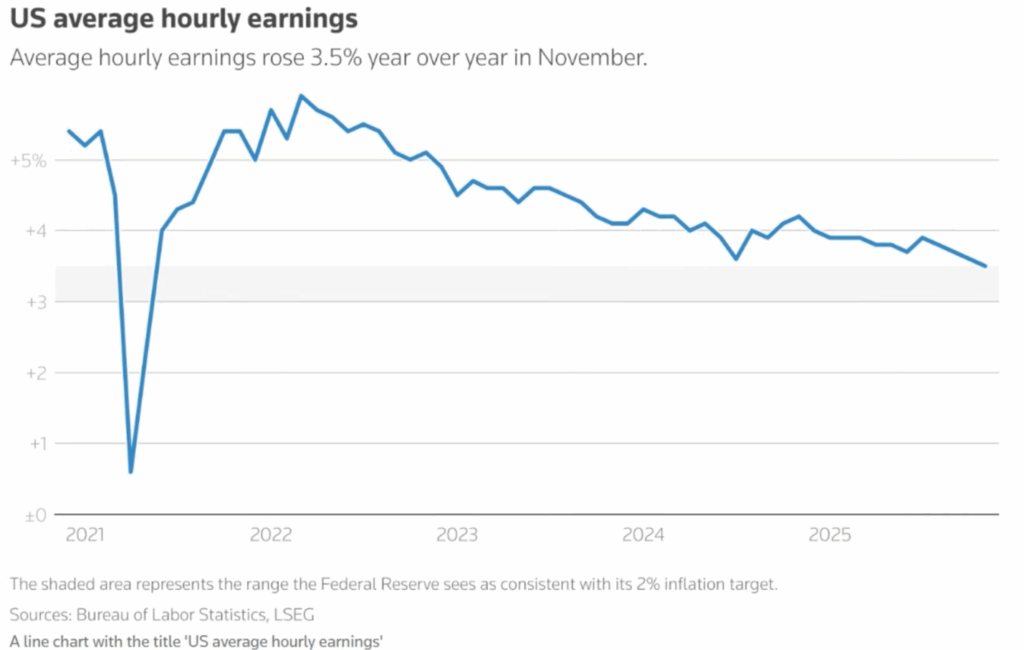
Another metric the Fed looks at, when deciding on interest rates, is hourly wage growth.

And it’s not looking much better…

Hourly earnings rose 3.5% year over year.

You might think, “Well inflation is 2.7% but wages are up 3.5%, so the American worker is winning, right?”

Wrong.

The real inflation is closer to 6%.

You see, the CPI basket – the goods and services tracked to determine inflation – has not seen a major revision since the 90s.

It doesn’t reflect consumer reality.

For example, what was your cell phone bill in 1995? Zero. Today it’s probably a couple hundred bucks. Things like childcare and medical costs eat up a much larger portion of incomes today than they did 30 years ago.

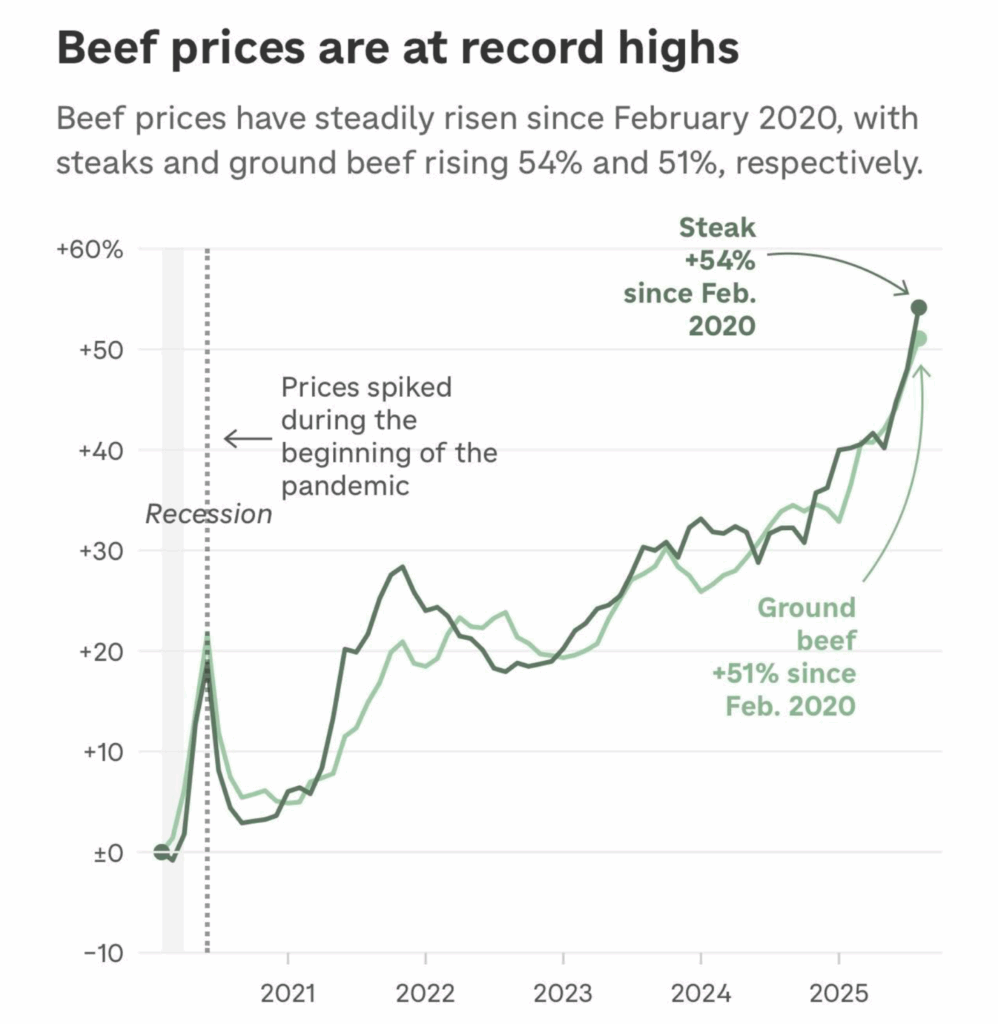
Beef and steak prices, which are a staple in my house, are up more than 50%.

So, if real inflation is closer to 6%, that means wages are not keeping pace with inflation. So not only are more people losing their jobs, but the ones that have them are seeing pay cuts in terms of actual purchasing power.

This week’s data is going to unshackle the Federal Reserve. Not only are we likely to see another 25bps rate cut in January, there is a chance we could see an even bigger 50bps cut as an emergency measure to rescue the labor market.

And while all of us benefit from lower interest rates in the short term, they are going to make inflation worse over the long term.

Especially with the Federal Reserve’s announcement that they would be turning the money printers on again.

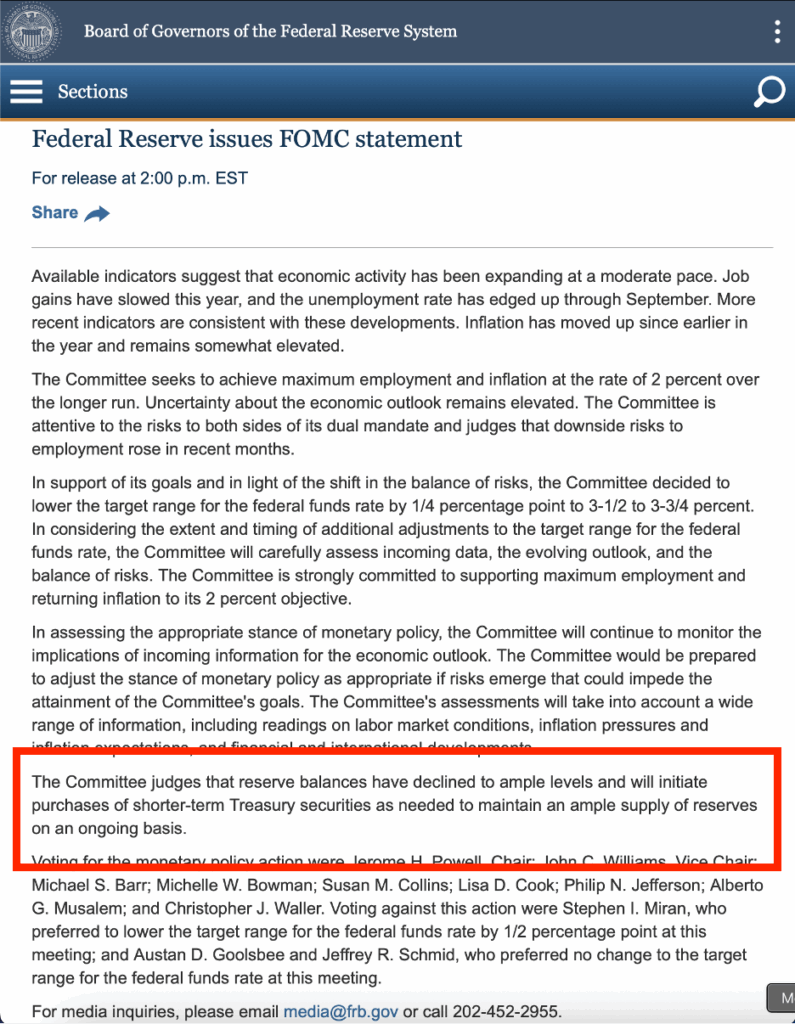
Powell didn’t mention it. The Fed tried to downplay it. But here it is, at the bottom of the official press release.

The Fed is ending its policy of quantitative tightening. They are done shrinking the balance sheet.

And will now “initiate purchases of shorter-term Treasury securities as needed to maintain an ample supply of reserves.”

So, they’re going to start buying bonds. Powell says $40-$60 billion worth a month. Where do they get the money to buy those bonds?

They print it. It is created out of thin air. Billions of dollars of new money flooding the system.

And this produces, as it always has, only one possible outcome…

More inflation.

More dollars chasing the same number of goods and services makes prices go up. That’s it. It’s not any more complicated than that.

And that’s exactly what the Fed has done for the last hundred years.

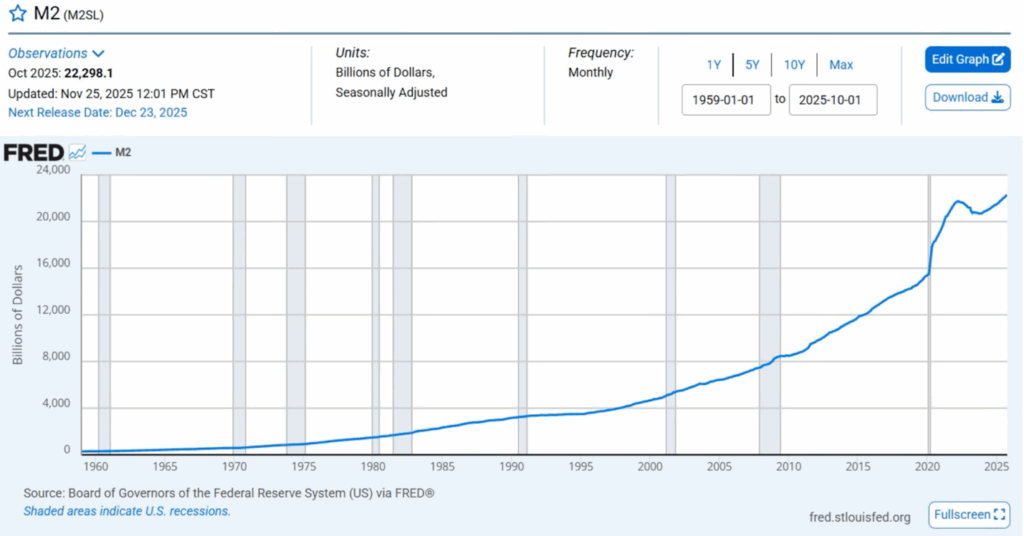
This is the M2 money supply – how much money is in the US economic system. $23 trillion and climbing.

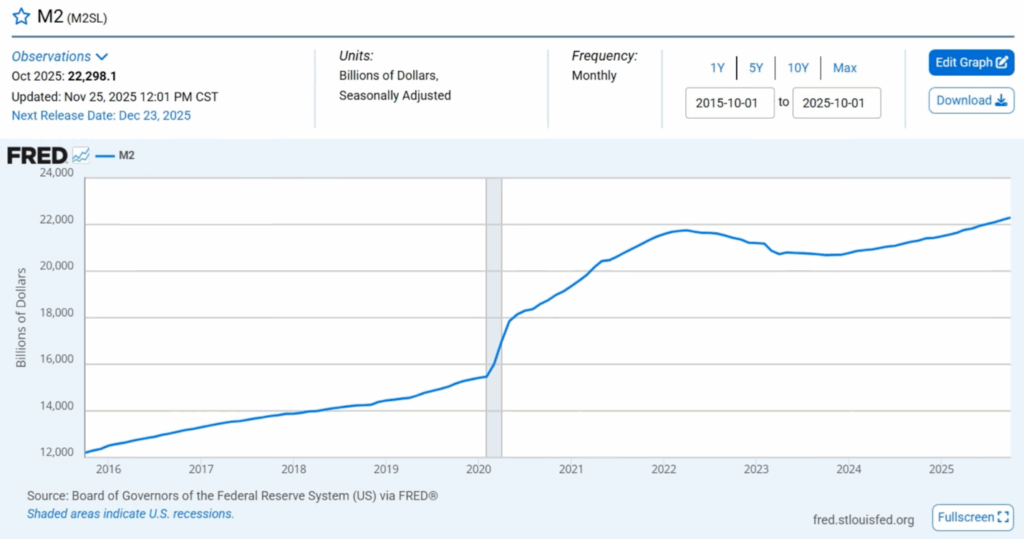
Here’s a closer look at the last ten years…

You can see the huge jump in 2020 when the government printed trillions of dollars for stimulus and bailouts. They kept spending into early 2022 until the Fed pivoted and began shrinking its balance sheet.

Remember the 2022 bear market? This, coupled with big rate hikes to fight inflation, are what caused it.

Anyway, the money supply has been growing at an annualized rate of approximately 5%.

And that’s with healthy +3% GDP growth… in a period of rising interest rates with the Fed shrinking its balance sheet.

Now the money printers are turned back on.

Interest rates are being cut. So, there’s going to be even more money loaned into existence.

We also have a federal government with $2 trillion dollars a year in deficit spending. That’s 2 trillion dollars more than it brought in that has to be printed just to make ends meet.

Interest payments on our debt now exceed the defense budget.

Think about that for a second…

The US government pays more in interest… on money they already spent… than it spends on the military.

And heads up… it’s not going to get better. The spending, the deficit, our national debt… it’s only going to get worse.

So, what does all this mean going forward? Here’s my outlook…

Money printing, which the Fed is again doing, raises stock prices.

The same inflationary forces that drive up housing and food prices also push stock prices higher.

Lower interest rates are also good for stocks.

It lowers margin rates, brings in new money from money markets and fixed income, and allows stock valuations to rise and remain competitive with dwindling bond yields.

And with this month’s inflation report coming in lower than expected and a labor market on life support, the Fed will have no choice but to cut again in January – another quarter or even half percentage point.

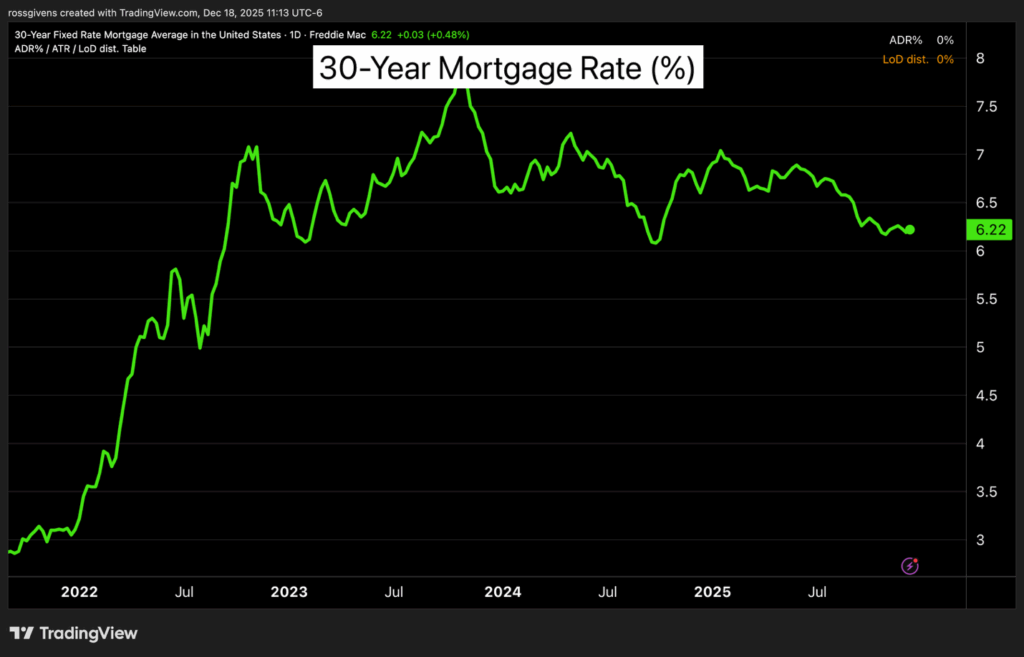
 If you’ve been waiting to buy a house or refinance your 7% mortgage, 2026 will likely be your best opportunity.

Mortgage rates will likely fall into the high 5s in the first quarter and possibly to as low as 4.5% by the end of the year…

It just depends on how aggressive Trump’s new Fed Chair pick decides to be.

My guess is that he comes out swinging.

But when the inevitable inflation shows up, they’ll have no choice but to raise interest rates again. So don’t expect another 2021 scenario with 2.7% mortgages.

The writing on the wall is clear. This is one of the best times to own assets and a hugely bullish backdrop for the stock market.

Best wishes for your trading,

Weekly Update: 3 Stocks Driving the Next AI Wave

Good evening, and welcome to this week’s edition of Stealth Trades!

Artificial intelligence remains the major theme of the stock market. But money is rotating out of the obvious plays (chipmakers like Nvidia) into new companies that will allow AI to scale.

Earlier this year we saw huge moves in nuclear stocks as Wall Street bet big on a clean energy solution to address the power shortage for data centers.

We also saw big momentum in quantum computing stocks – an offshoot of the AI play.

But today I am seeing a new theme develop in the AI space – optical core cables. These specialized data cables will allow data centers to move data at much higher speeds – well in excess of the limits of today’s copper versions.

I won’t get too technical, but here’s the basics of it…

Data centers (the ones that power all the artificial intelligence models) are essentially giant warehouses of computer servers. Those servers are mounted in 6-foot tall racks that look like this:

Data is transferred between the servers, compute notes and top-of-rack switch via advanced copper data cables.

But copper has a limit to how much data it can transfer at high speed.

Today, most AI server racks are operating at a speed of 112Gbps. They move 112 gigabytes of data every second. But they can only do so for a distance of 2 meters. Past that, the cables suffer signal loss.

The next generation AI infrastructure will operate at 224 Gbps. At that speed, cable can move data less than 1 meter before running into problems.

By 2028, servers are expected to push data at a lightning fast 1.6 terabytes per second – 14 times today’s rate which is already pushing the physical limits of modern data cables.

A lot of this is beyond my technical comprehension, but the consensus bet is on a transition to linear drive optics. And there are three companies leading this move.

I am not recommending these as an official buy, but I would encourage traders to keep them on your watchlist. I’m watching for clean setups in these names and would welcome any opportunity to get in.

MACOM Technology Solutions (MTSI)

MACOM’s high-performance analog chips could become the most critical components in the chain. They possess a rare, high-barrier analog pedigree that digital-first competitors lack. Their 30% revenue growth is primarily driven by data center demand, and they are uniquely positioned to profit as the industry shifts to custom optical engines.

Fabrinet (FN)

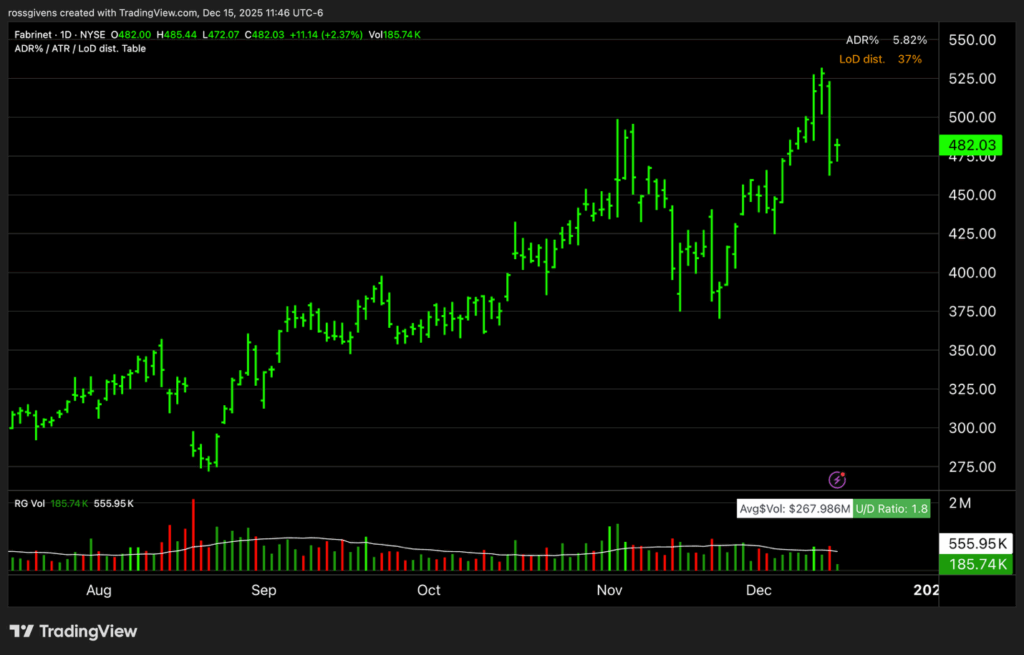
Fabrinet feels like a less risky play here since, instead of betting on new technology, it just executes the manufacturing for the winners. As the primary manufacturer for Nvidia’s complex optical interconnects and a key partner for Lumentum and Coherent, they are an inevitable beneficiary of volume growth. 

Coherent Corp (COHR)

This company manufactures something called indium phosphide lasers and modulators, which would allow speeds up to 1.6Tbps.

You’ll notice that all three of these charts look similar – strong trends heading to the upper right. This correlation is further evidence that Wall Street is making a bet in this specialized sub-sector.

Best wishes for your trading,

Weekly Update: 8 Reasons Stocks Will Keep Rising

Good evening, and welcome to this week’s edition of Stealth Trades!

The stock market is already up big from the April lows. But in all likelihood, this is just the beginning.

Here are 5 reasons I believe stocks will continue to advance in 2026:

#1 – The biggest technological advancement of our lifetime

Artificial intelligence is rapidly increasing efficiency and driving down costs. We haven’t seen a boom like this since the internet in the 1990s. And the Nasdaq index surged 271% in the final 16 months of that bull market.

#2 – Ongoing Fed rate cuts into a stock market at all-time highs

This has happened 23 times in the last fifty years. In every case, stocks were higher a year later. Check out the data below.

#3 – Trump’s appointment of a new Federal Reserve Chairman

Powell’s term ends in May. Don’t let the door hit you on the way out, JPow. President Trump has picked his replacement and will announce it by next month.

The consensus is that he will tap Kevin Hassett – a Trump ally who believes in aggressively cutting interest rates and lower corporate taxes. Both actions lead to higher stock prices.

#4 – $700 billion in annual CapEx from tech companies

Thanks to the AI arms race, big tech is spending 700 billion a year on chips, data centers and other infrastructure. All of that money is leaving their company treasuries and entering the economy.

#5 – The end of Quantitative Tightening

As of December 1st, the Federal Reserve ended its QT program. They have been reducing their balance sheet for over a year which added selling pressure to the market. That has now come to an end.

#6 – The most market-conscious US President ever

Love him or hate him, Trump views the stock market as his presidential scoreboard. He wants to see GDP growth, foreign investments, and record profits reflected in the market indexes. He’s even said he will fight to keep markets at all-time highs.

#7 – $2 trillion in annual deficit spending

I hate deficits. The fact that our government takes a third of our income and still can’t make ends meet is disgusting. No sitting member of Congress who votes to spend more than we take in should be allowed to run for re-election.

But nobody asks me. So, this is the game board we must play on. And the facts are simple…

The deficit will continue to widen. The debt will keep going up. And Washington will print money to fill the gap like it always has. Inflation will get worse, and it will push stock prices up with it.

#8 – 13% year-over-year earnings growth in the S&P 500

Historically, earnings grow at about 9% a year. That is the long-term average for the S&P 500 since 1957. This year they grew at 13%. That’s almost 50% above the norm. And earnings drive stock prices.

I don’t see how anyone could be bearish and think the market will crash under these conditions.

Are valuations stretched? Sure.

Will some of today’s high-flying AI stocks come crashing one day? Absolutely.

But markets operate on liquidity. If there is more money going in than out, prices rise. And this is exactly the scenario we are in today.

The bull market continues.

Best wishes for your trading,